Smart Home Threat Taxonomy
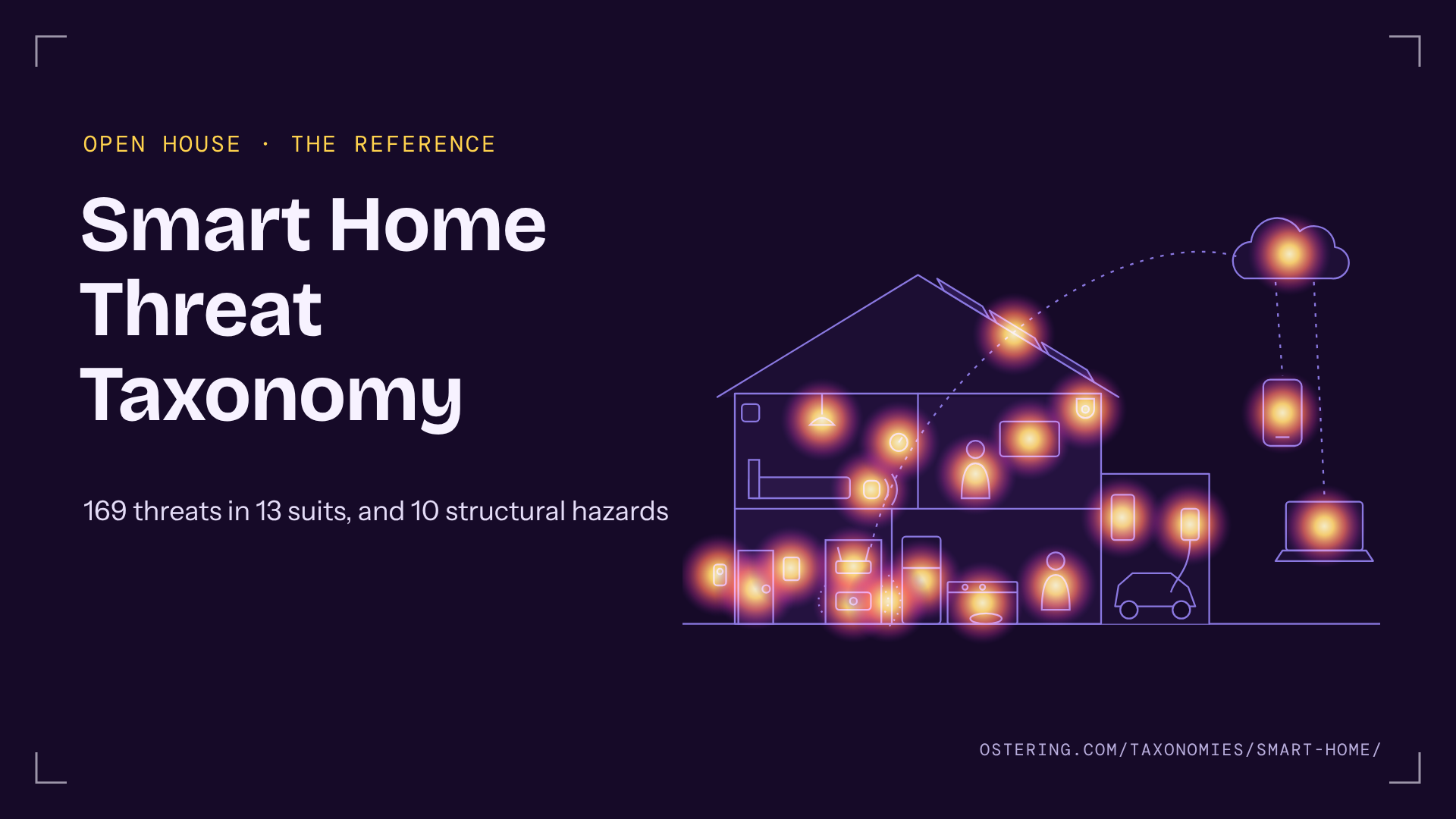
This is the reference for the Open House card game: every card’s threat, the mitigation principle a sound design follows, design measures, and mappings to STRIDE, CAPEC and CWE.
The Smart Home Threat Taxonomy v1.0 has 169 threats in 13 suits, and 10 structural hazards that cut across the whole house. Seven suits are the things in the house; six are the control around it, from the router and the vendor’s cloud to the people who live there and the lifecycle of every device.
IDs
Every entry has an ID in three parts joined by hyphens: OPH for Open House, the suit code and the card value. OPH-CM-Q is the Queen of Cameras and Doorbells; OPH-TR-3 is the third structural hazard. The ID on each entry is the ID printed on its card, so a threat model, a ticket or a write-up that cites OPH-CM-Q points to the same threat whether the reader has the deck or this page. Please cite the ID when you use an entry.
The house
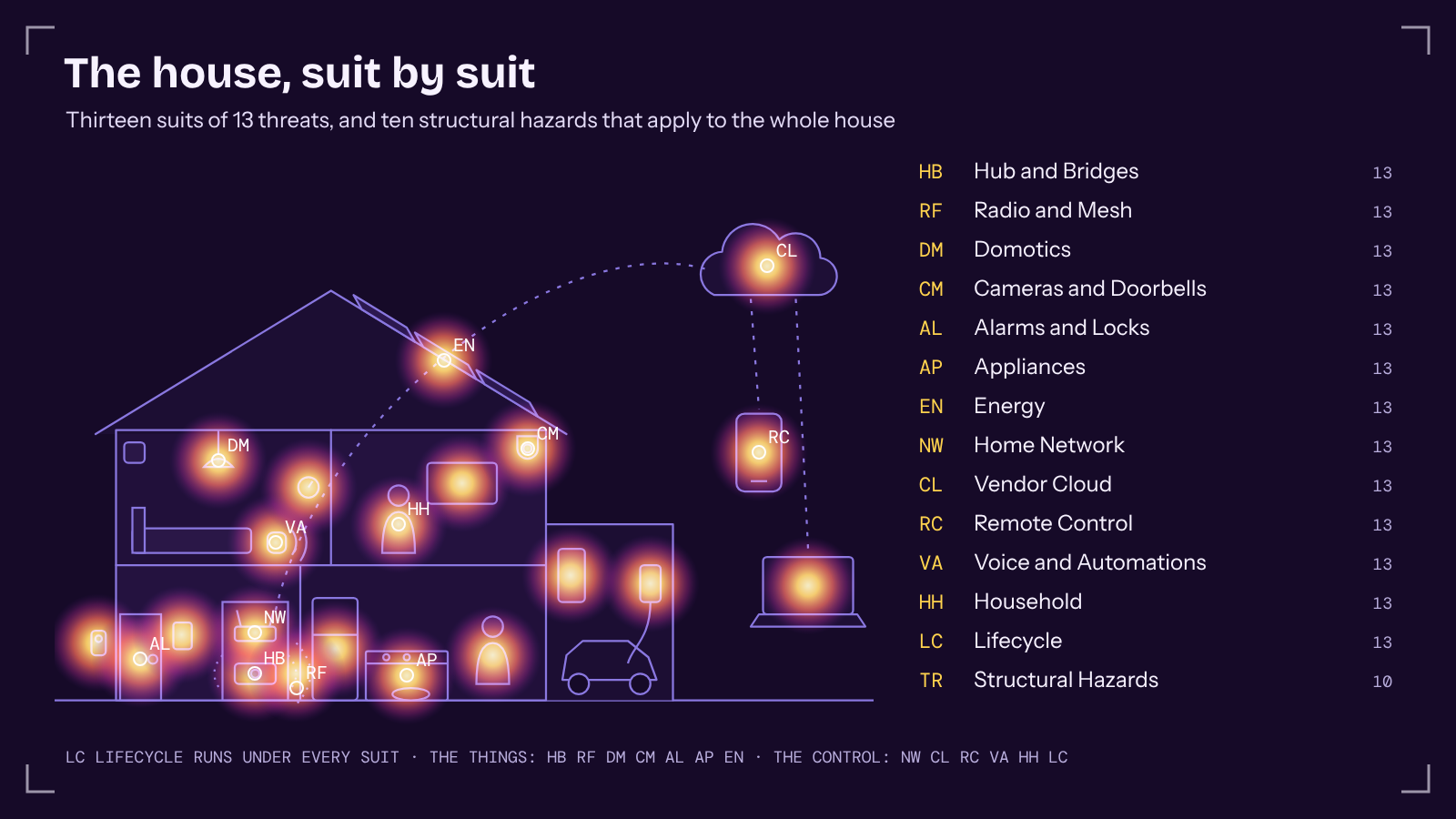
Every suit has a place in the house. The Things sit inside it, from the solar panels on the roof to the hub in the hall cupboard; the Control sits around it, in the router, the vendor’s cloud and the phone and computer that drive it from anywhere. Lifecycle runs under every suit, and the ten structural hazards apply to the whole house at once.
Two decks
The game splits the taxonomy into two decks that can be played on their own or one after the other. Each deck has its own suits (seven in The Things, six in The Control), the ten structural hazards as Trumps, a quick-reference card and a taxonomy card that links back here.
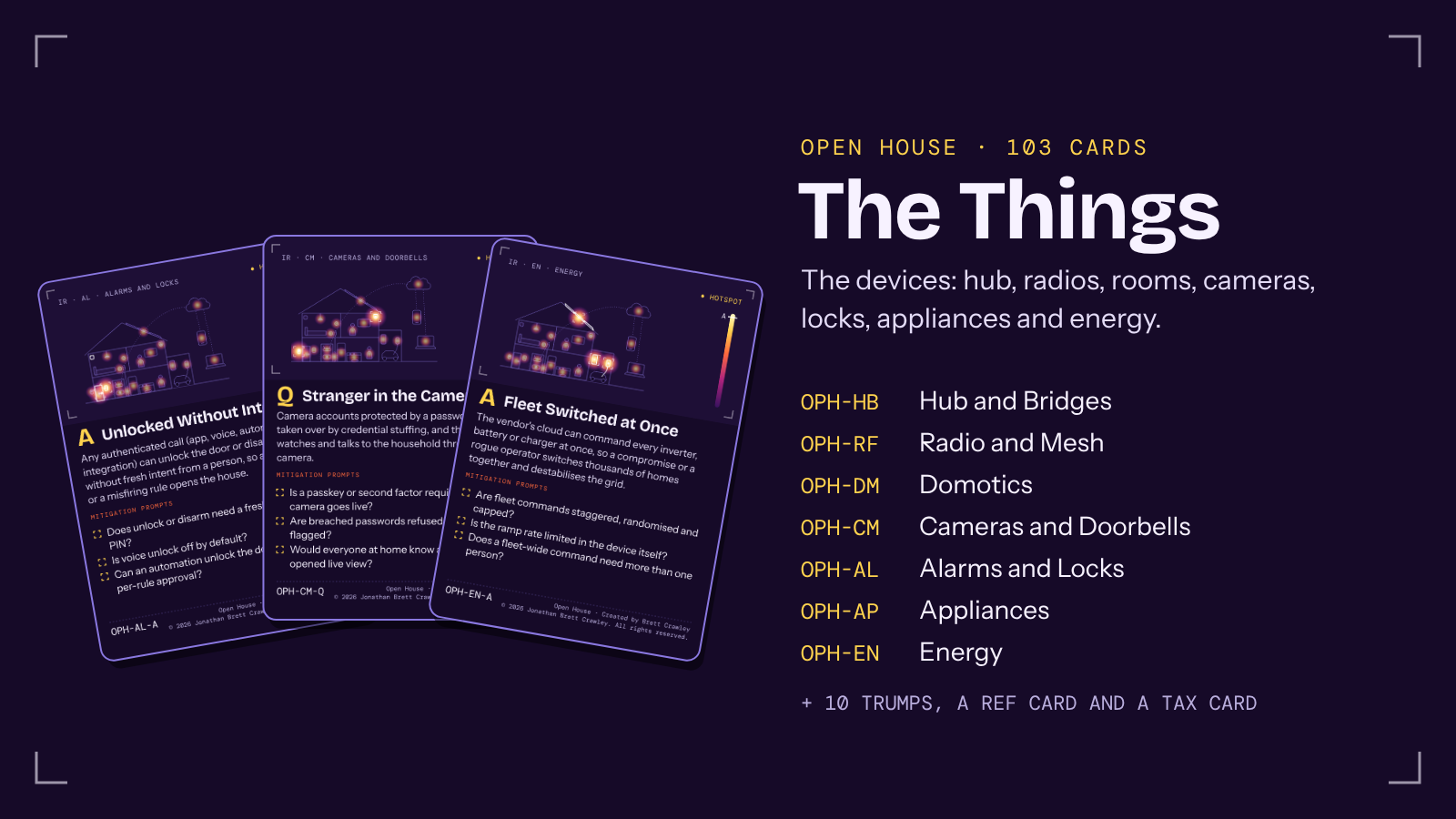
The Things (103 cards) is the devices: what is in the house and what each one can do to the people in it.
- Hub and Bridges (OPH-HB)
- Radio and Mesh (OPH-RF)
- Domotics (OPH-DM)
- Cameras and Doorbells (OPH-CM)
- Alarms and Locks (OPH-AL)
- Appliances (OPH-AP)
- Energy (OPH-EN)
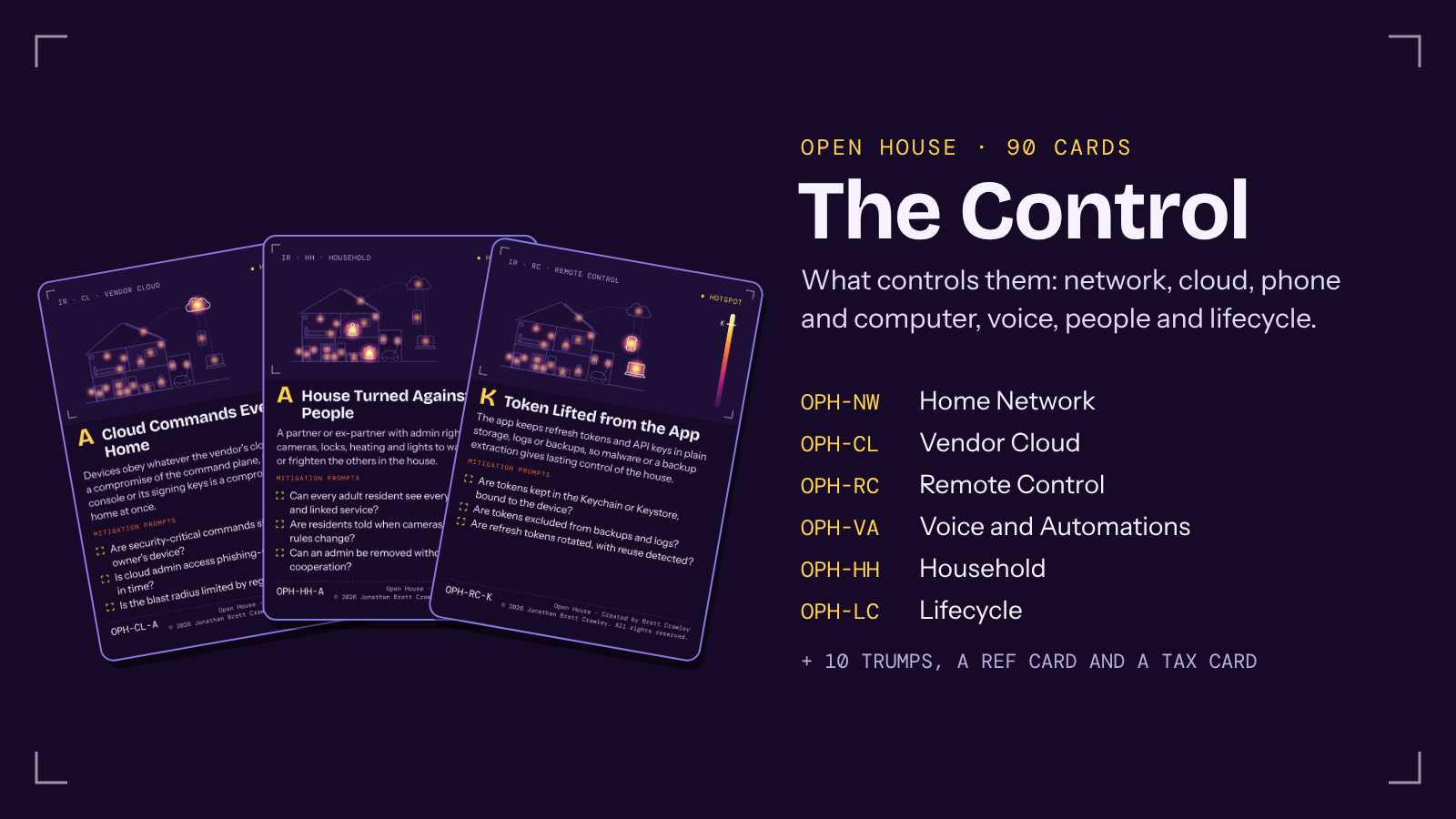
The Control (90 cards) is what controls the devices: the network, the vendor’s cloud, the apps, the voice assistant and its rules, the people who live there and the lifecycle of every device.
- Home Network (OPH-NW)
- Vendor Cloud (OPH-CL)
- Remote Control (OPH-RC)
- Voice and Automations (OPH-VA)
- Household (OPH-HH)
- Lifecycle (OPH-LC)
Suits
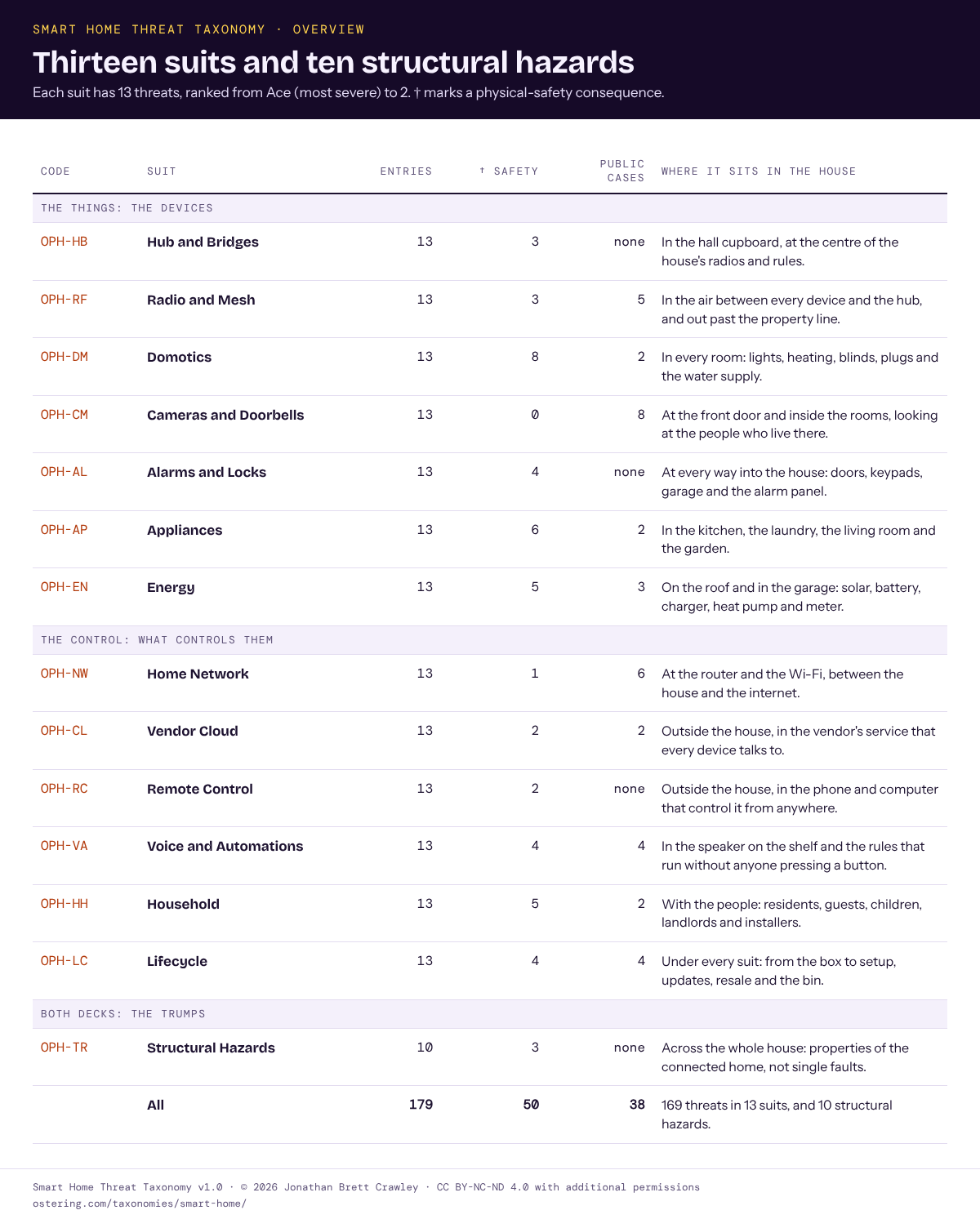
The table counts 50 entries with a physical-safety consequence and 38 with a public case, linked from the suit pages. Four groups have no public case yet: Hub and Bridges, Alarms and Locks, Remote Control and the structural hazards. If you know of one, send it in.
Structural hazards
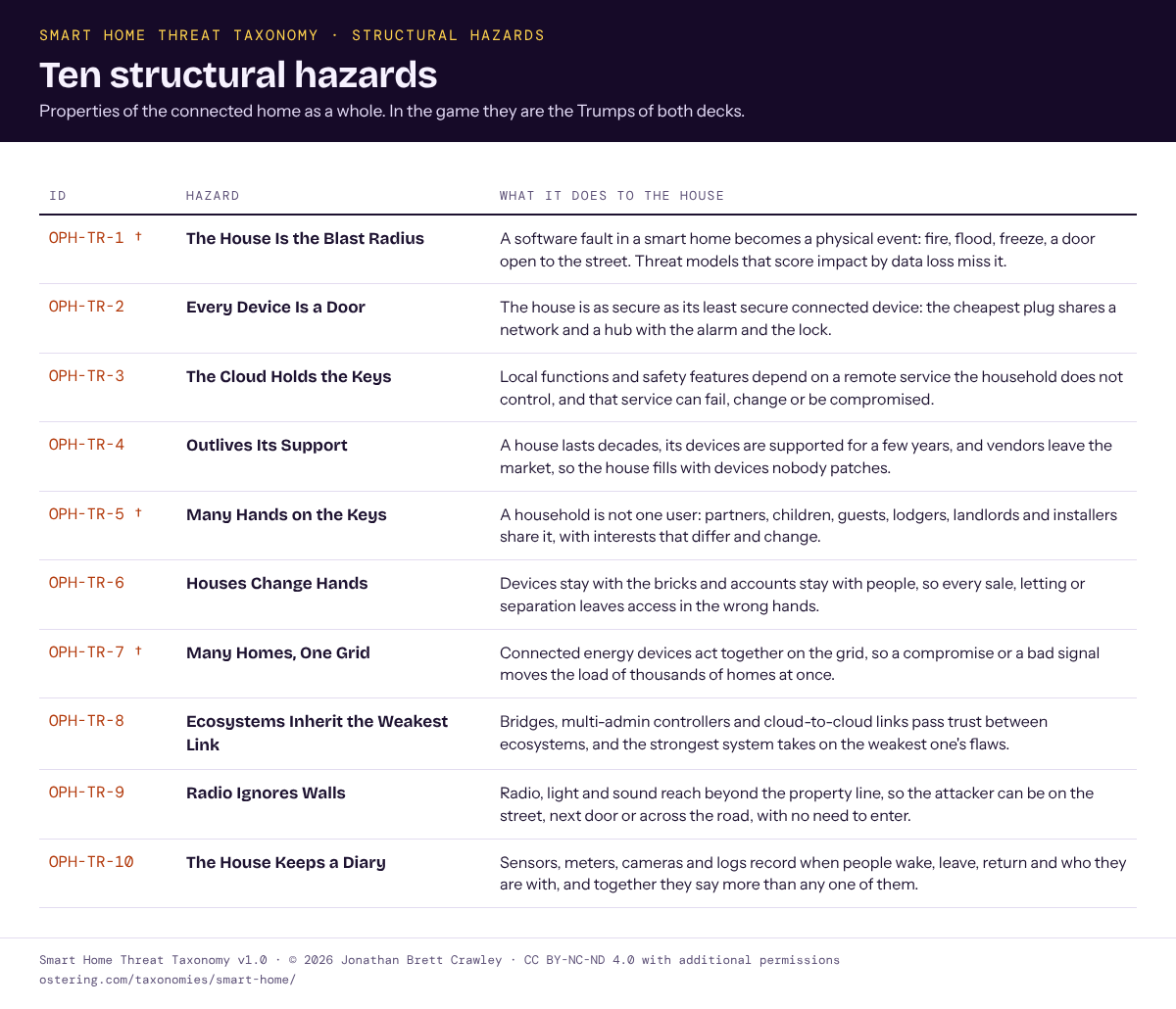
Structural hazards are properties of the connected home as a whole, not single faults. In the game they are the Trumps, in both decks. Their principles, measures and mappings are on the Structural Hazards page.
How to read an entry
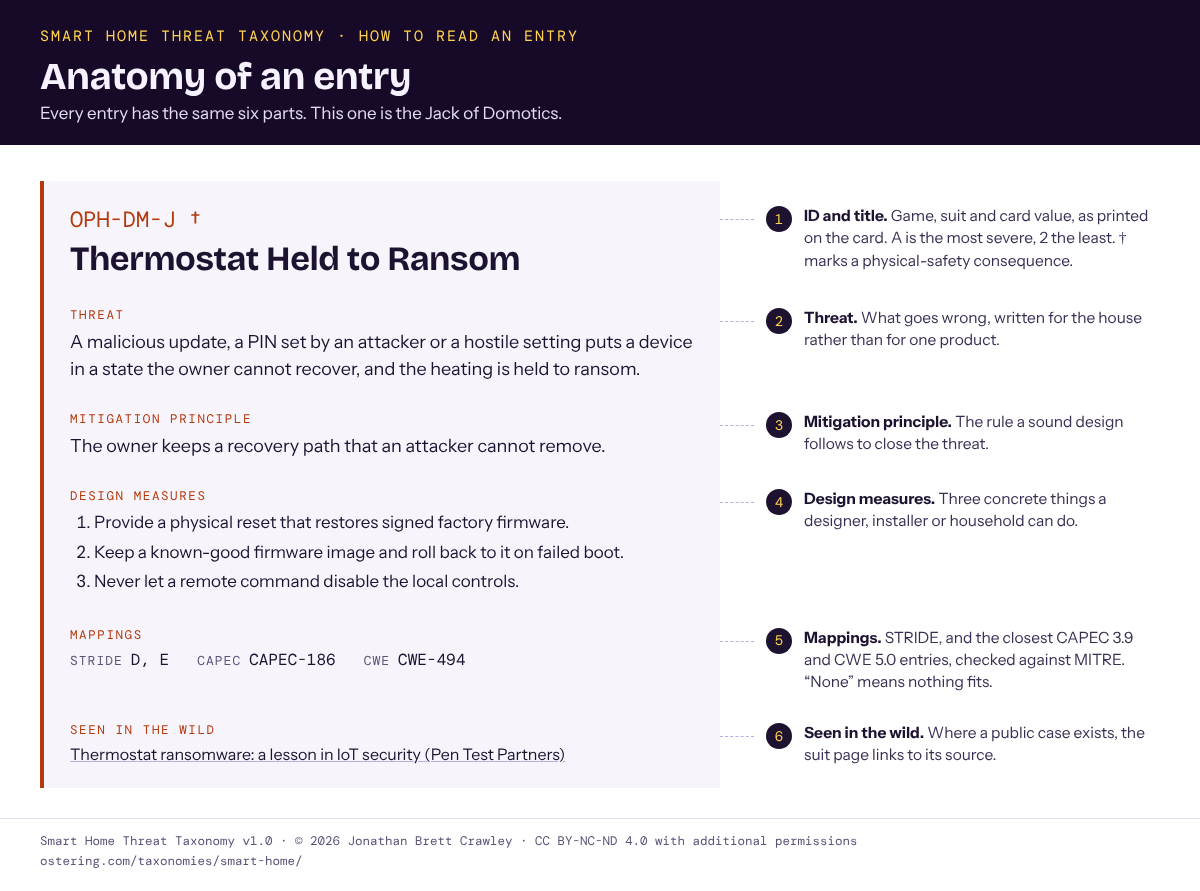
Each suit page has the full table as an image, and the same entries in text below it. Every entry has the same parts:
- Value. Within a suit, values rank severity: A is the most severe, 2 the least. Structural hazards are numbered 1 to 10.
- Threat. What goes wrong, written for the house rather than for one product.
- Mitigation principle. The rule a sound design follows to close the threat.
- Design measures. Three concrete things a designer, installer or household can do.
- STRIDE. The STRIDE categories the threat falls under.
- CAPEC and CWE. The closest entries in CAPEC 3.9 and CWE 5.0. Empty cells are deliberate: many smart home threats, such as a landlord keeping camera access to a tenant’s home (OPH-HH-J), have no equivalent.
- † The threat has a physical-safety consequence: heat, water, fire, a door left open or a person hurt.
- Seen in the wild. Where a public case exists, the suit page links to the source.
The mapping post explains how each STRIDE, CAPEC and CWE mapping was chosen and checked.
Downloads
- smart-home-threat-taxonomy.pdf (PDF, 454 KB). A4 landscape, one section per suit, licence on the first page. For reading and printing.
- smart-home-threat-taxonomy.xlsx (Excel, 120 KB). One sheet per suit, an all-entries sheet and a licence sheet. Filter by STRIDE, CAPEC, CWE or physical safety.
- smart-home-threat-taxonomy.skos.jsonld (SKOS, JSON-LD, 197 KB). A SKOS concept scheme: one concept per suit and per entry, with closeMatch and broadMatch links to CAPEC and CWE. For knowledge graphs and vocabulary tools.
- smart-home-threat-taxonomy.stix.json (STIX 2.1, 610 KB). A bundle with an attack-pattern and a course-of-action per entry, linked by mitigates relationships and grouped by suit. For threat intelligence platforms.
Every download carries the licence below. The SKOS and STIX files use the same IDs, so a tool that imports either can link back to this page.
Licence
The Smart Home Threat Taxonomy is © 2026 Jonathan Brett Crawley. It is licensed under the Creative Commons Attribution-NonCommercial-NoDerivatives 4.0 International licence (CC BY-NC-ND 4.0).
Additional permissions. As the copyright holder, I also give you permission, beyond the terms of CC BY-NC-ND 4.0, to:
- use the taxonomy in commercial threat modeling work, including paid engagements and the threat models you deliver to clients;
- use it for internal training in your organisation;
- quote individual entries, with attribution and a link to this page.
You need my written permission to ship the taxonomy, in whole or in part, in a product or service, including tools, games and training courses sold to others.
Attribution: Smart Home Threat Taxonomy v1.0, Brett Crawley, https://ostering.com/taxonomies/smart-home/
The taxonomy is the reference for the Open House card game. Its entries are the game’s cards, with the same IDs.
Read more
- Every connected home fails open somewhere: the article behind the taxonomy.
- Mapping the Smart Home Threat Taxonomy: how the STRIDE, CAPEC and CWE mappings were made.
- Open House: a threat modeling game for the connected home: the launch post for the game.
- All taxonomies