Alarms and Locks
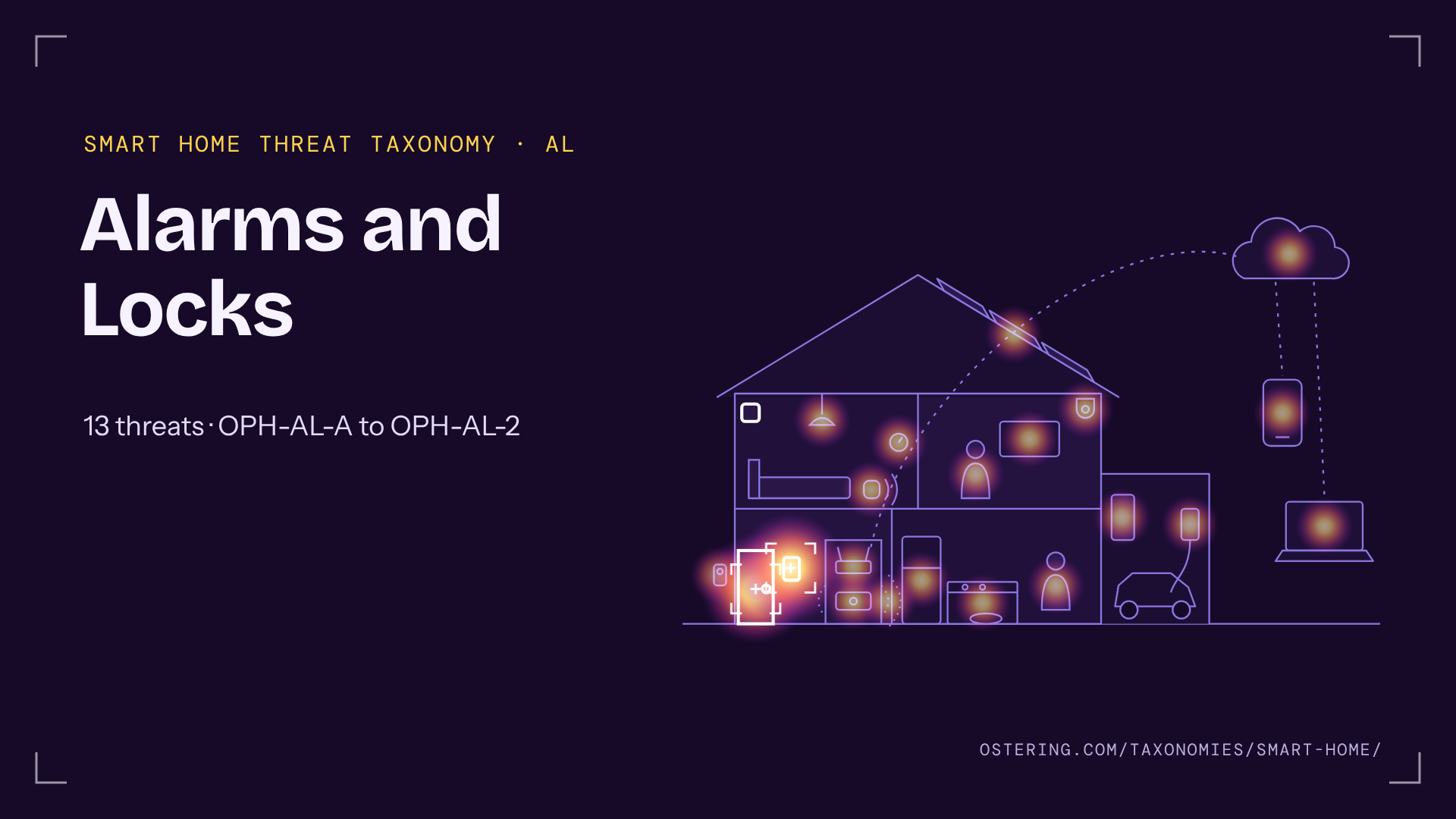
Smart Home Threat Taxonomy › Alarms and Locks (OPH-AL)
Intrusion alarms, smoke and carbon monoxide alarms, smart locks, keypads, garage doors and gates: the devices that decide who comes in and whether anyone hears about it.
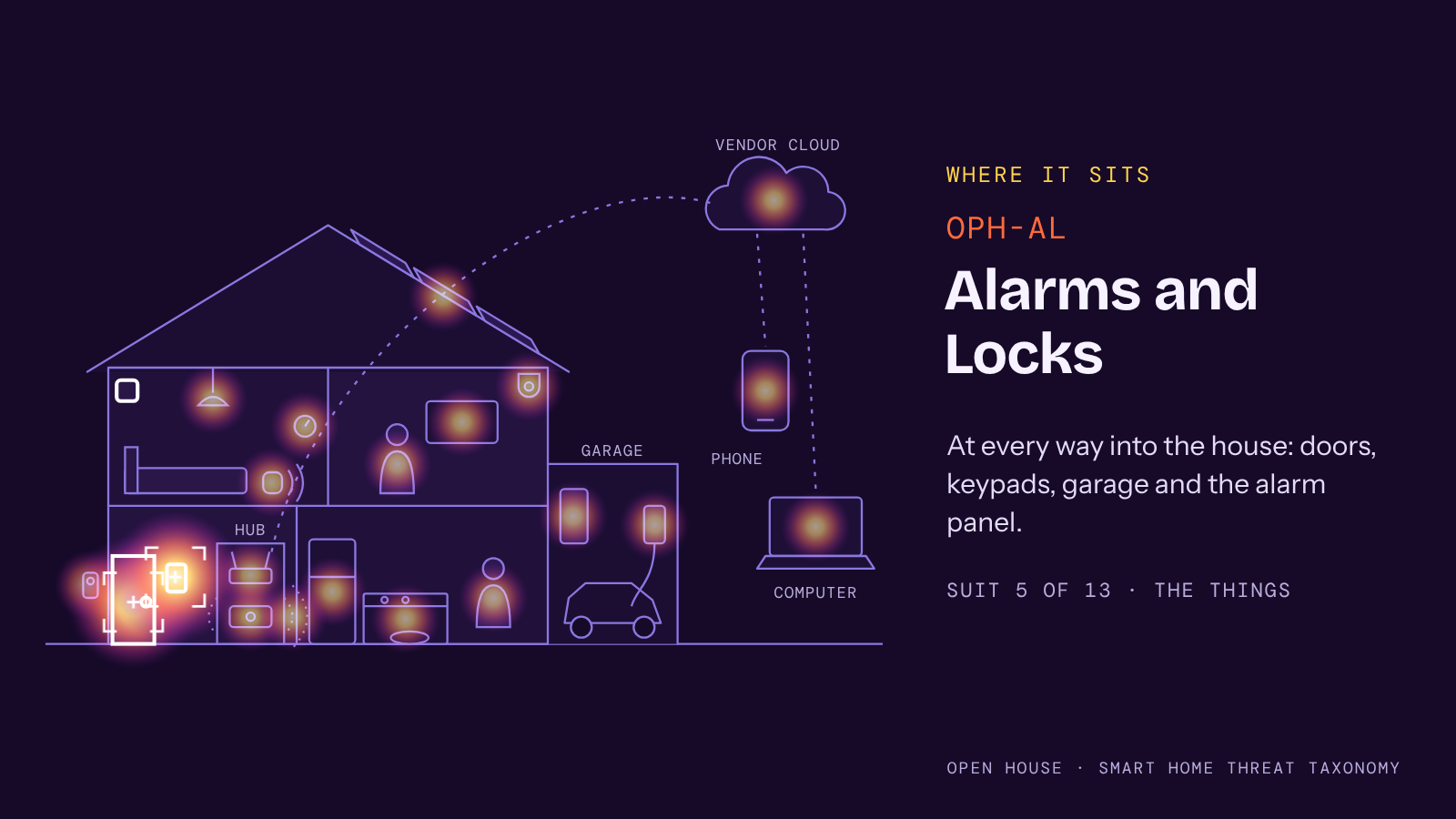
Where it sits in the house
The Alarms and Locks suit sits at every way into the house: doors, keypads, garage and the alarm panel. It is suit 5 of 13, in the Things deck.
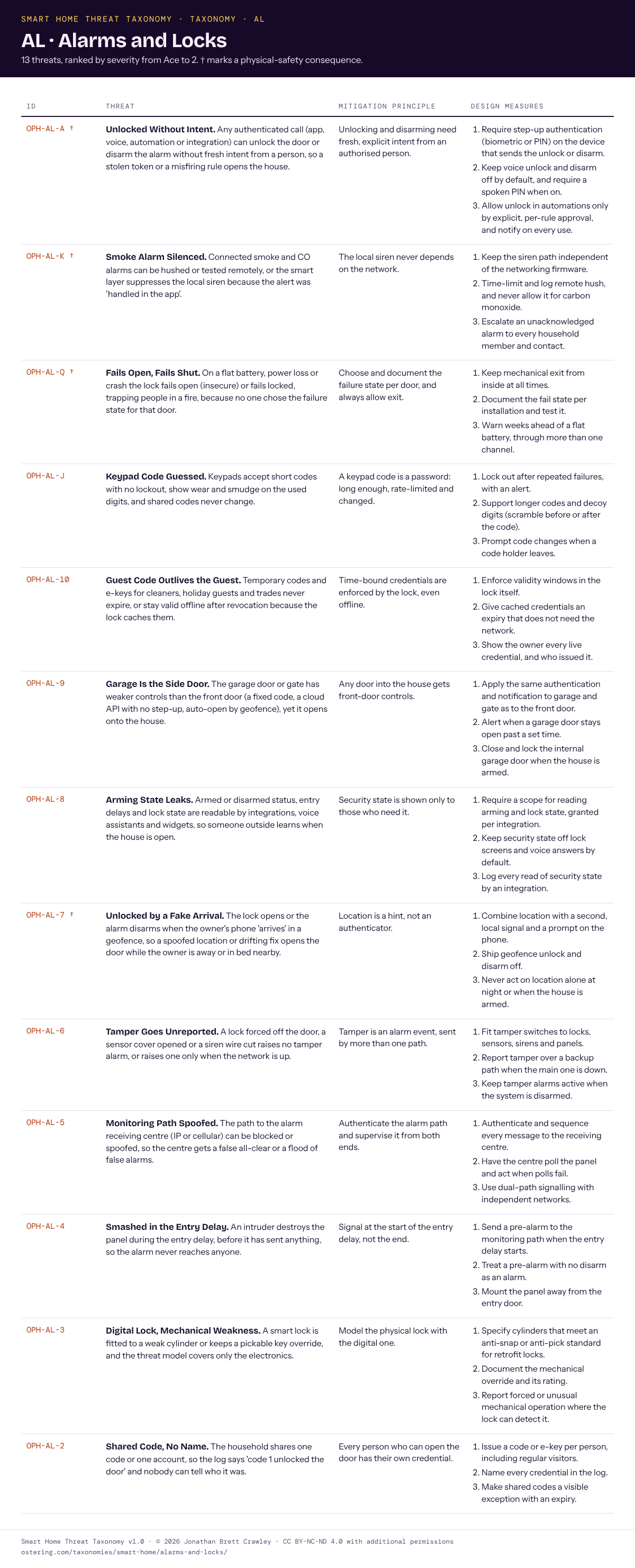
The table
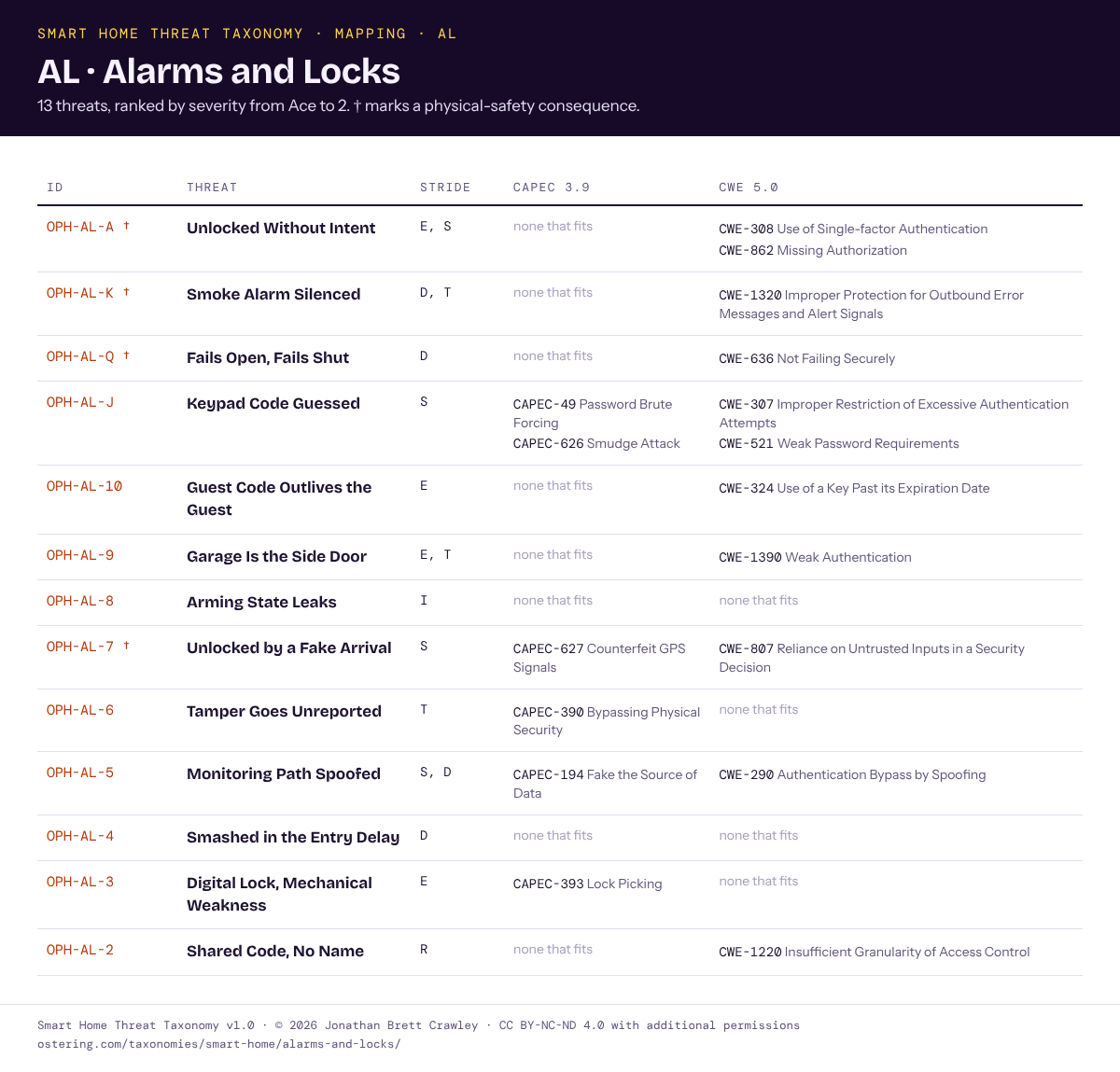
Mappings
Entries in text
- OPH-AL-A † Unlocked Without Intent. Any authenticated call (app, voice, automation or integration) can unlock the door or disarm the alarm without fresh intent from a person, so a stolen token or a misfiring rule opens the house.
- OPH-AL-K † Smoke Alarm Silenced. Connected smoke and CO alarms can be hushed or tested remotely, or the smart layer suppresses the local siren because the alert was ‘handled in the app’.
- OPH-AL-Q † Fails Open, Fails Shut. On a flat battery, power loss or crash the lock fails open (insecure) or fails locked, trapping people in a fire, because no one chose the failure state for that door.
- OPH-AL-J Keypad Code Guessed. Keypads accept short codes with no lockout, show wear and smudge on the used digits, and shared codes never change.
- OPH-AL-10 Guest Code Outlives the Guest. Temporary codes and e-keys for cleaners, holiday guests and trades never expire, or stay valid offline after revocation because the lock caches them.
- OPH-AL-9 Garage Is the Side Door. The garage door or gate has weaker controls than the front door (a fixed code, a cloud API with no step-up, auto-open by geofence), yet it opens onto the house.
- OPH-AL-8 Arming State Leaks. Armed or disarmed status, entry delays and lock state are readable by integrations, voice assistants and widgets, so someone outside learns when the house is open.
- OPH-AL-7 † Unlocked by a Fake Arrival. The lock opens or the alarm disarms when the owner’s phone ‘arrives’ in a geofence, so a spoofed location or drifting fix opens the door while the owner is away or in bed nearby.
- OPH-AL-6 Tamper Goes Unreported. A lock forced off the door, a sensor cover opened or a siren wire cut raises no tamper alarm, or raises one only when the network is up.
- OPH-AL-5 Monitoring Path Spoofed. The path to the alarm receiving centre (IP or cellular) can be blocked or spoofed, so the centre gets a false all-clear or a flood of false alarms.
- OPH-AL-4 Smashed in the Entry Delay. An intruder destroys the panel during the entry delay, before it has sent anything, so the alarm never reaches anyone.
- OPH-AL-3 Digital Lock, Mechanical Weakness. A smart lock is fitted to a weak cylinder or keeps a pickable key override, and the threat model covers only the electronics.
- OPH-AL-2 Shared Code, No Name. The household shares one code or one account, so the log says ‘code 1 unlocked the door’ and nobody can tell who it was.
† marks a physical-safety consequence. The full principle, measures and mappings for each entry are in the tables above and in the downloads.
Seen in the wild
No entry in this suit has a public case recorded in v1.0. That does not make the threats hypothetical; it means no case was found that matched an entry closely enough to cite. If you know of one, tell me and I will add it in the next version.
← Previous: Cameras and Doorbells · All suits · Next: Appliances →
Smart Home Threat Taxonomy v1.0 · © 2026 Jonathan Brett Crawley · Licensed under CC BY-NC-ND 4.0 with additional permissions.