Structural Hazards
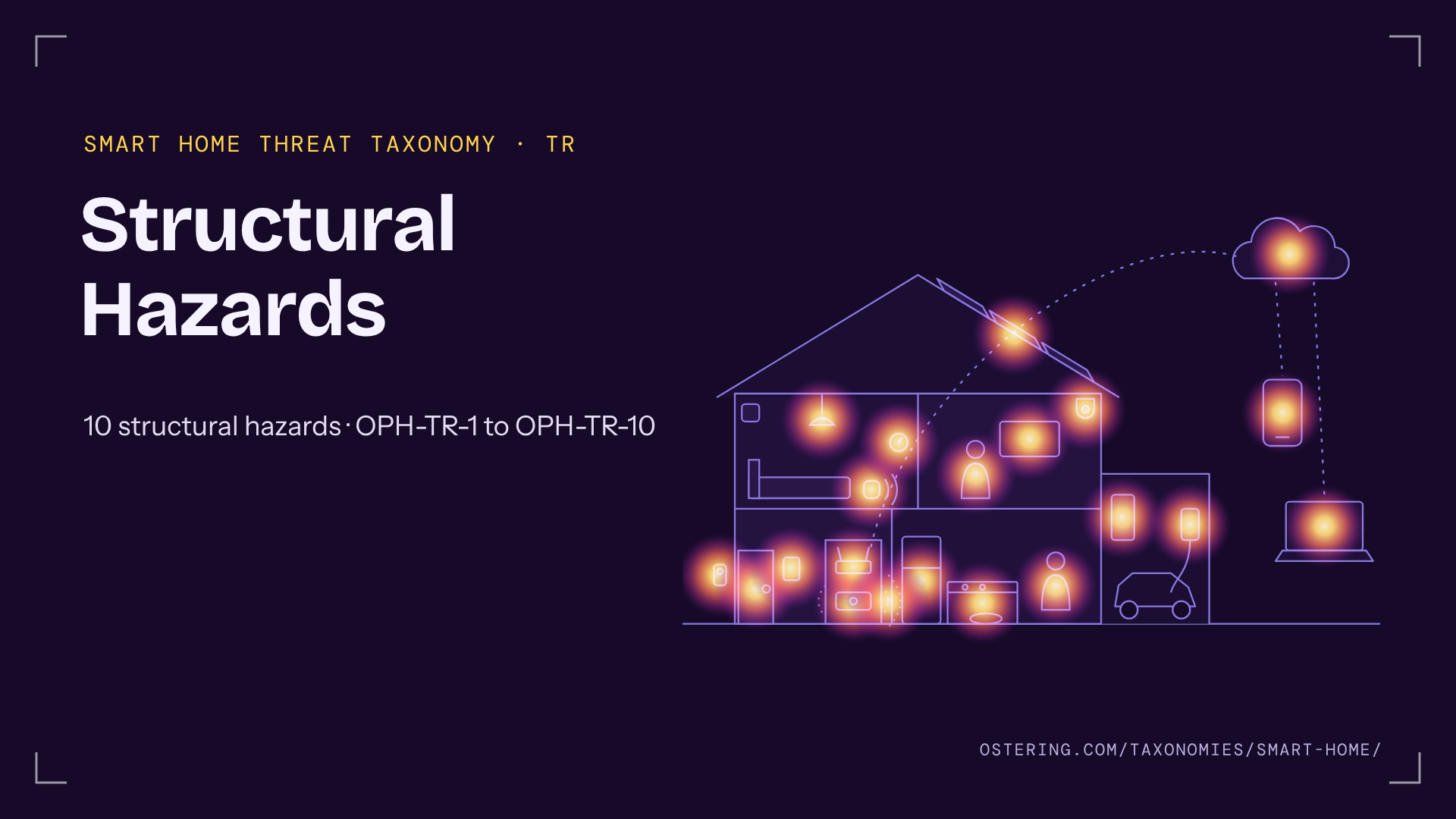
Smart Home Threat Taxonomy › Structural Hazards (OPH-TR)
Structural hazards are properties of the connected home as a whole, not single faults. In the game they play as Trumps, in both decks; deal them against the whole design before the suits.
In the game these are the Trumps, in both decks. Deal them against the whole design before the suits: each one asks whether the house as a whole has a property that makes single faults worse.
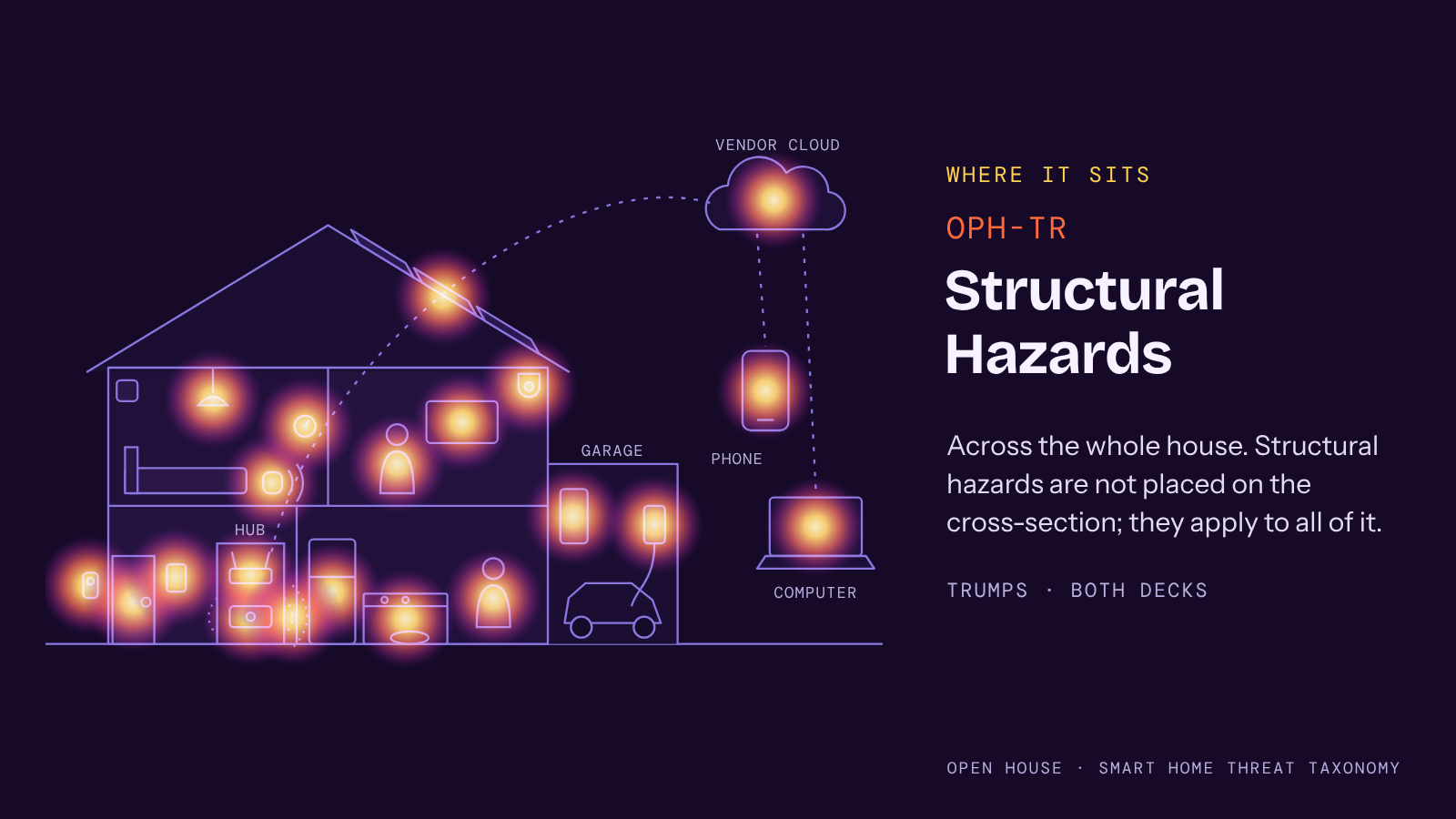
Where it sits in the house
Structural hazards sit across the whole house: properties of the connected home, not single faults. They are not placed on the cross-section; they apply to all of it.
The table
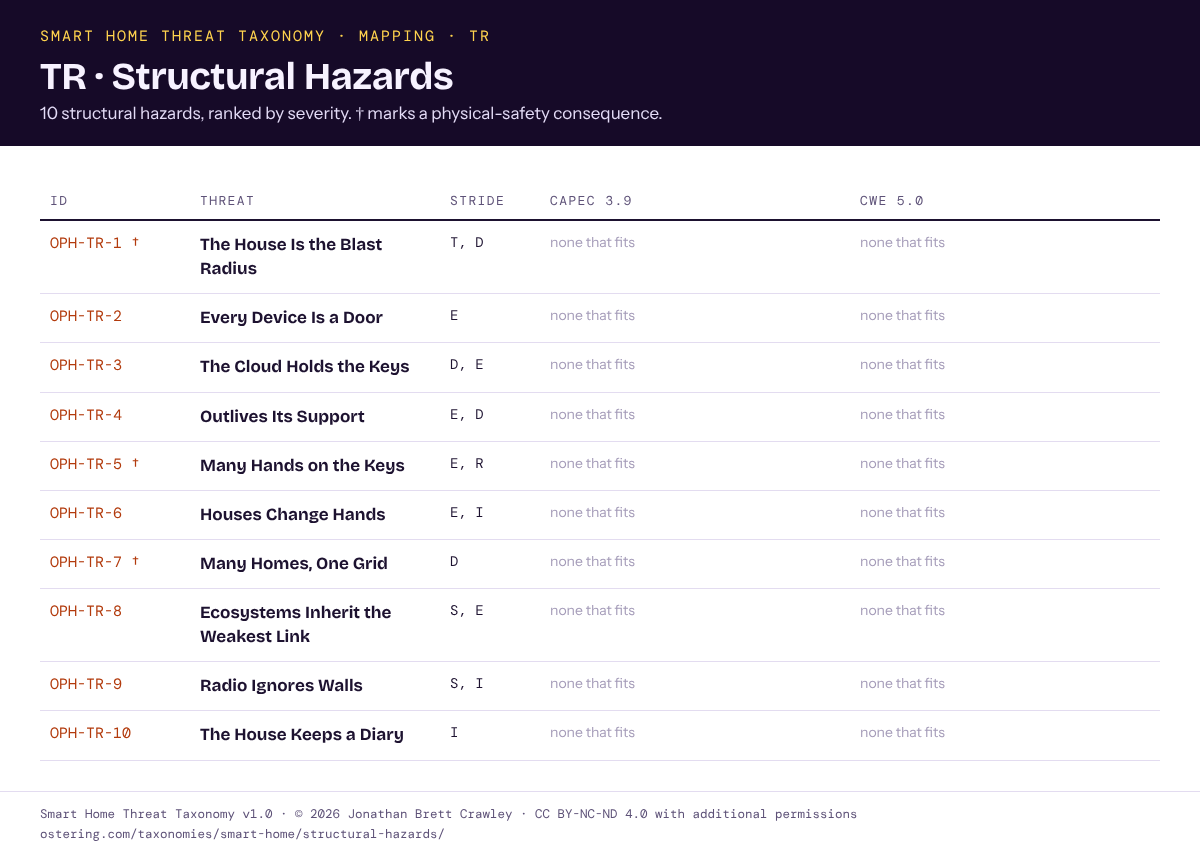
Mappings
Entries in text
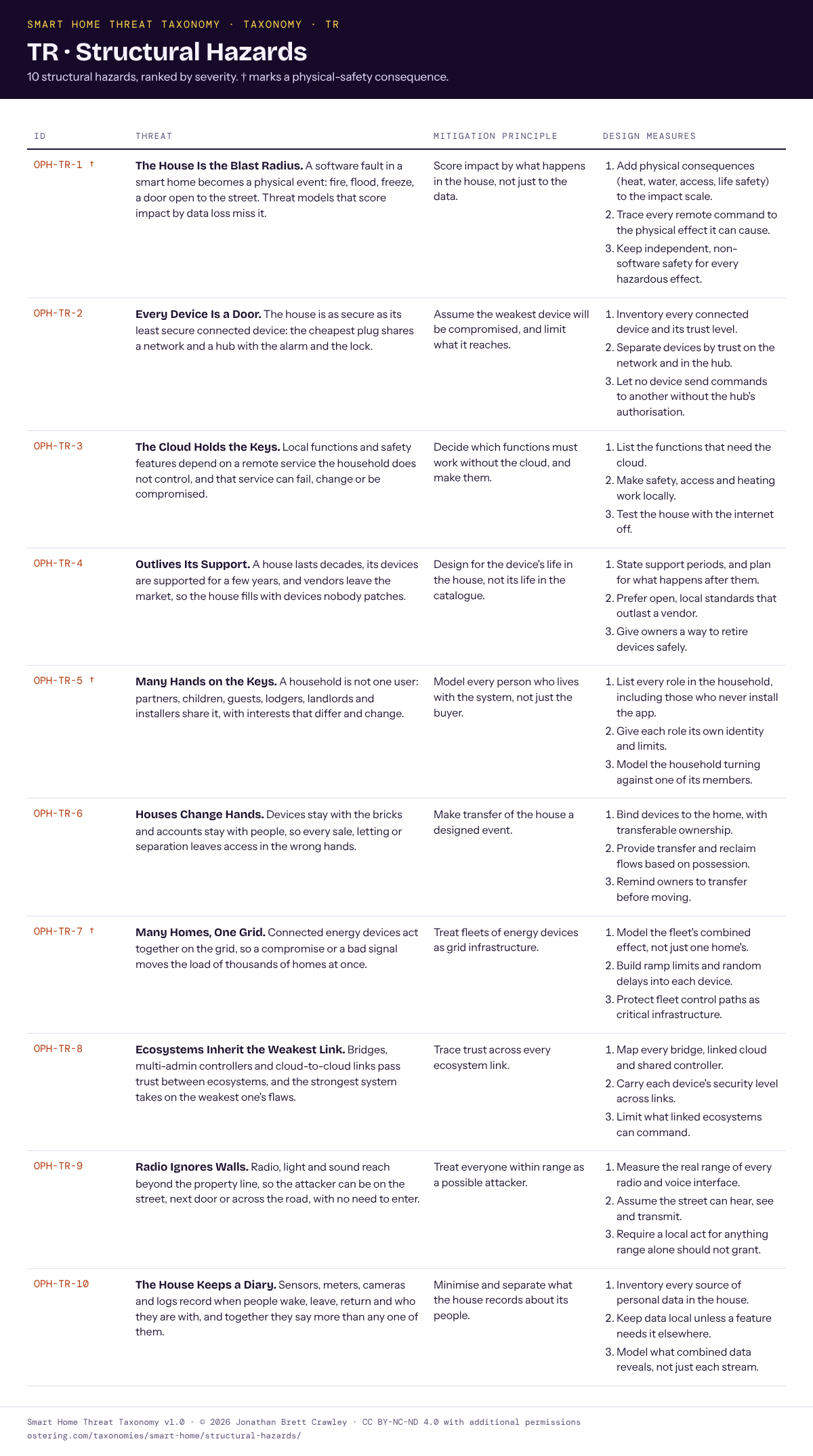
- OPH-TR-1 † The House Is the Blast Radius. A software fault in a smart home becomes a physical event: fire, flood, freeze, a door open to the street. Threat models that score impact by data loss miss it.
- OPH-TR-2 Every Device Is a Door. The house is as secure as its least secure connected device: the cheapest plug shares a network and a hub with the alarm and the lock.
- OPH-TR-3 The Cloud Holds the Keys. Local functions and safety features depend on a remote service the household does not control, and that service can fail, change or be compromised.
- OPH-TR-4 Outlives Its Support. A house lasts decades, its devices are supported for a few years, and vendors leave the market, so the house fills with devices nobody patches.
- OPH-TR-5 † Many Hands on the Keys. A household is not one user: partners, children, guests, lodgers, landlords and installers share it, with interests that differ and change.
- OPH-TR-6 Houses Change Hands. Devices stay with the bricks and accounts stay with people, so every sale, letting or separation leaves access in the wrong hands.
- OPH-TR-7 † Many Homes, One Grid. Connected energy devices act together on the grid, so a compromise or a bad signal moves the load of thousands of homes at once.
- OPH-TR-8 Ecosystems Inherit the Weakest Link. Bridges, multi-admin controllers and cloud-to-cloud links pass trust between ecosystems, and the strongest system takes on the weakest one’s flaws.
- OPH-TR-9 Radio Ignores Walls. Radio, light and sound reach beyond the property line, so the attacker can be on the street, next door or across the road, with no need to enter.
- OPH-TR-10 The House Keeps a Diary. Sensors, meters, cameras and logs record when people wake, leave, return and who they are with, and together they say more than any one of them.
† marks a physical-safety consequence. The full principle, measures and mappings for each entry are in the tables above and in the downloads.
Seen in the wild
No entry in this suit has a public case recorded in v1.0. That does not make the threats hypothetical; it means no case was found that matched an entry closely enough to cite. If you know of one, tell me and I will add it in the next version.
← Previous: Lifecycle · All suits
Smart Home Threat Taxonomy v1.0 · © 2026 Jonathan Brett Crawley · Licensed under CC BY-NC-ND 4.0 with additional permissions.