Household
Smart Home Threat Taxonomy › Household (OPH-HH)
The people in the house: partners, children, lodgers, guests, cleaners, landlords and installers. A smart home has many users with different interests, and most products model one owner.
Where it sits in the house
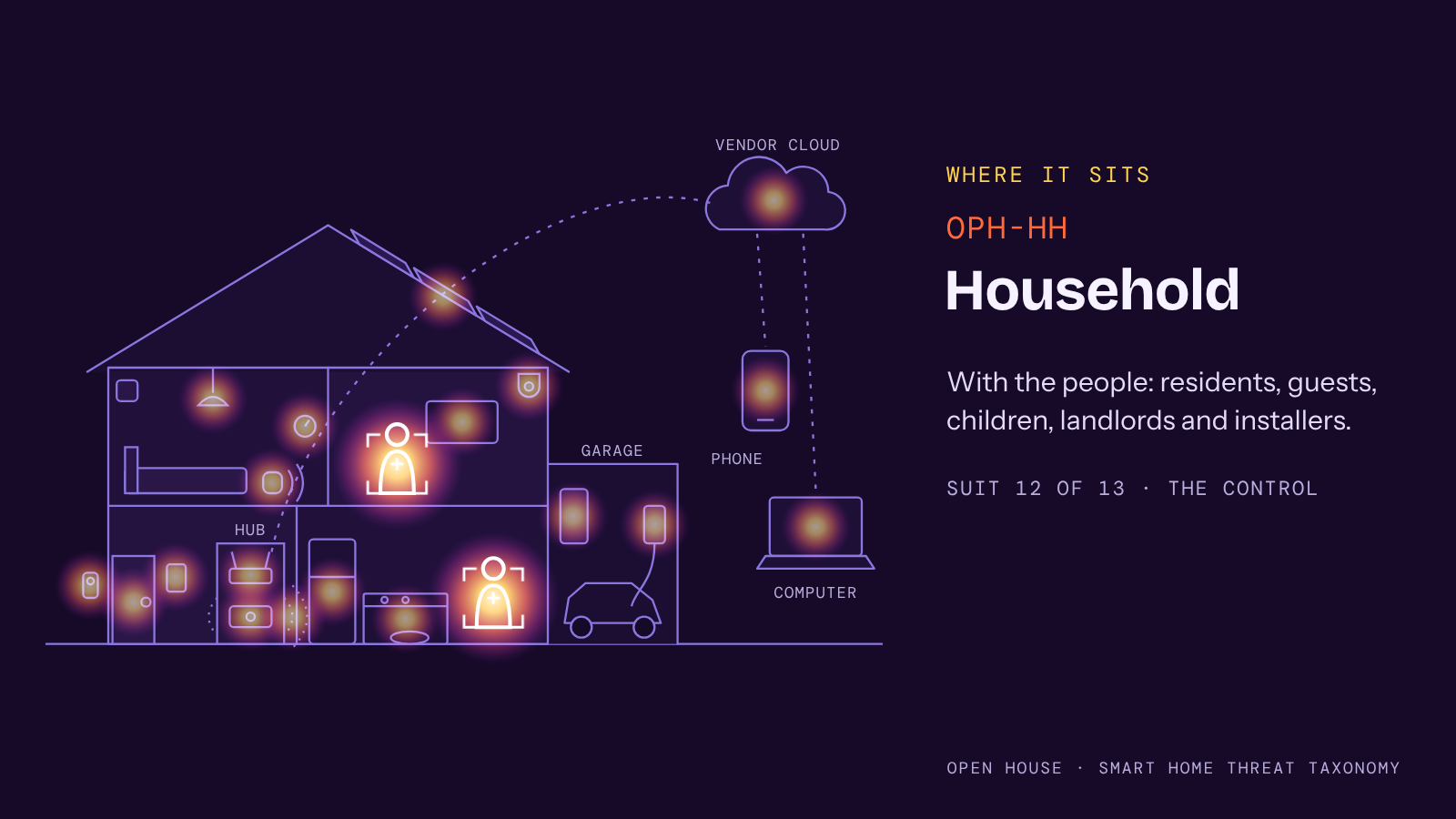
The Household suit sits with the people: residents, guests, children, landlords and installers. It is suit 12 of 13, in the Control deck.
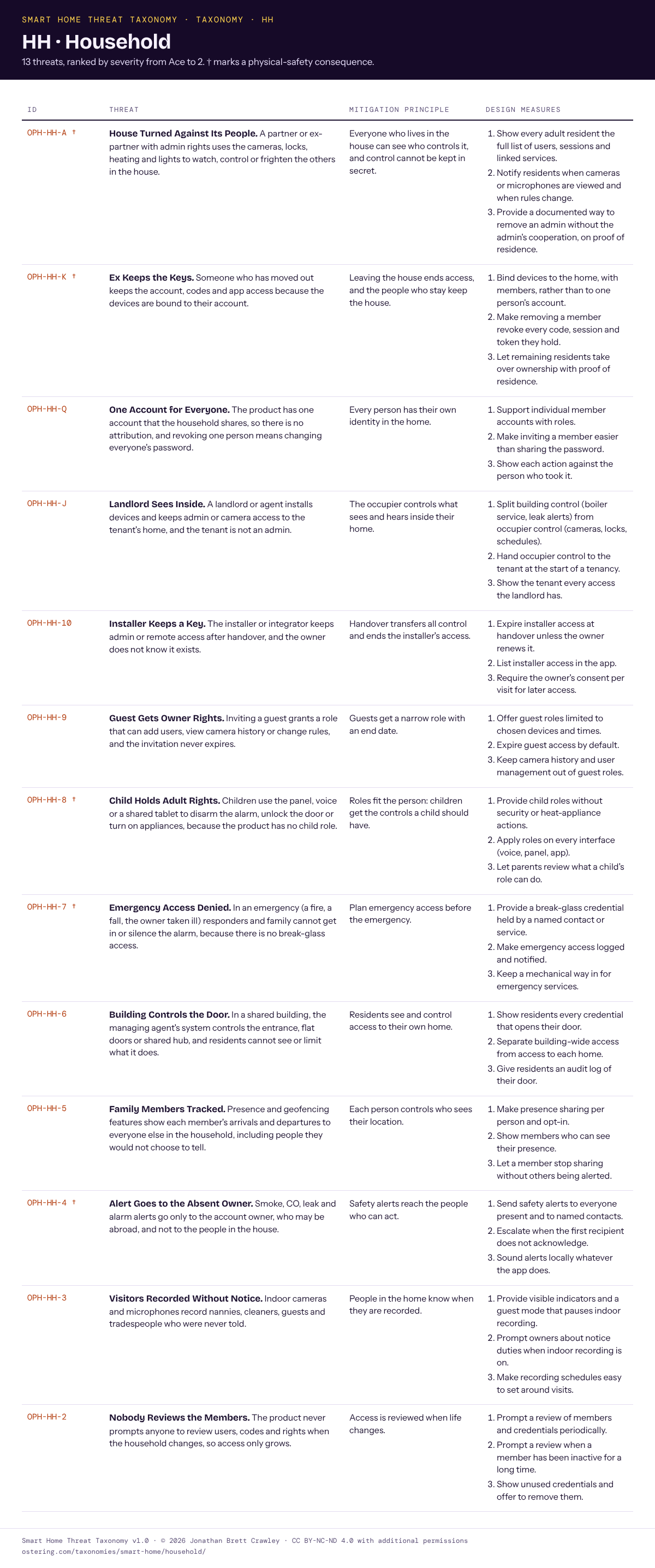
The table
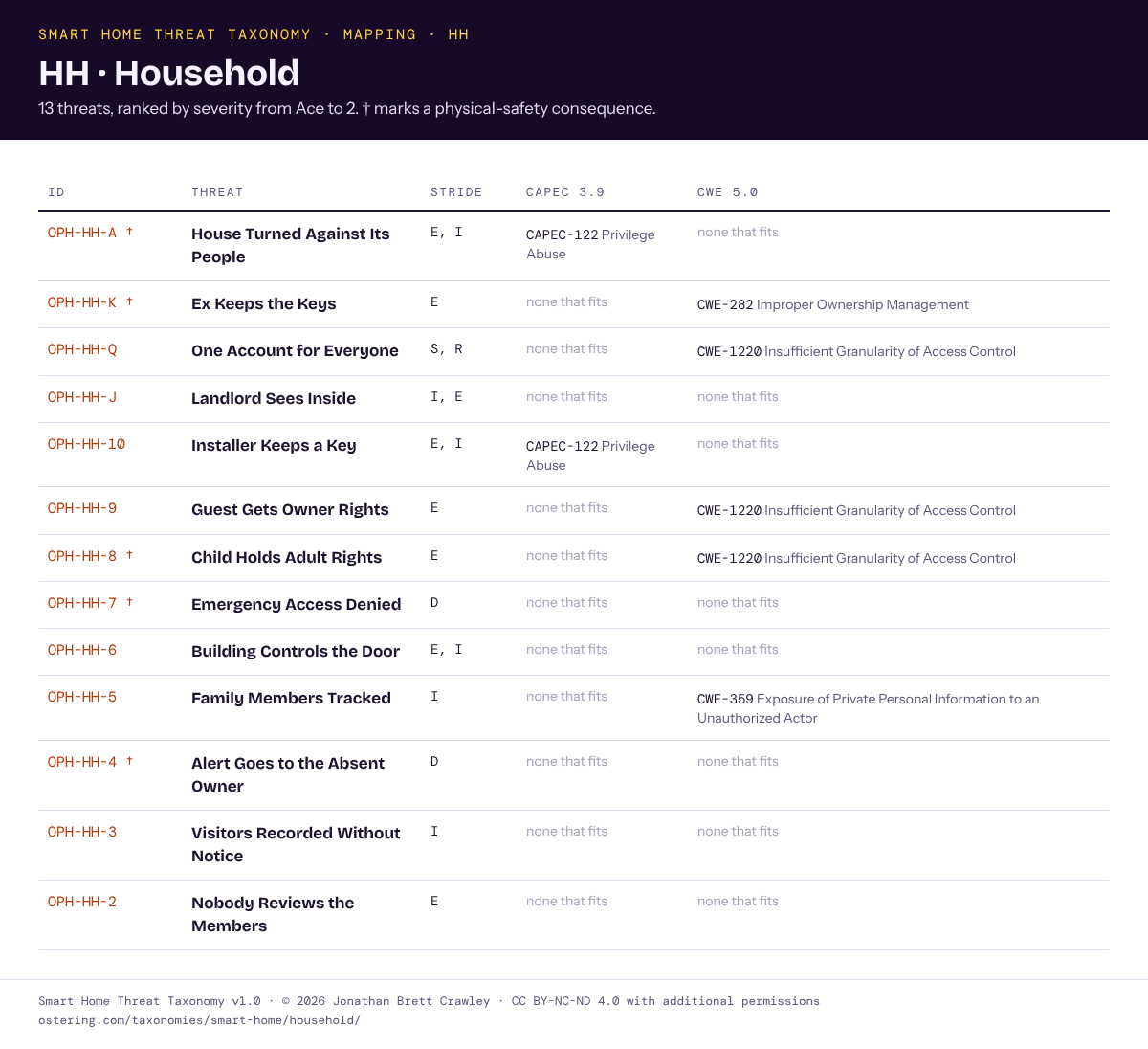
Mappings
Entries in text
- OPH-HH-A † House Turned Against Its People. A partner or ex-partner with admin rights uses the cameras, locks, heating and lights to watch, control or frighten the others in the house.
- OPH-HH-K † Ex Keeps the Keys. Someone who has moved out keeps the account, codes and app access because the devices are bound to their account.
- OPH-HH-Q One Account for Everyone. The product has one account that the household shares, so there is no attribution, and revoking one person means changing everyone’s password.
- OPH-HH-J Landlord Sees Inside. A landlord or agent installs devices and keeps admin or camera access to the tenant’s home, and the tenant is not an admin.
- OPH-HH-10 Installer Keeps a Key. The installer or integrator keeps admin or remote access after handover, and the owner does not know it exists.
- OPH-HH-9 Guest Gets Owner Rights. Inviting a guest grants a role that can add users, view camera history or change rules, and the invitation never expires.
- OPH-HH-8 † Child Holds Adult Rights. Children use the panel, voice or a shared tablet to disarm the alarm, unlock the door or turn on appliances, because the product has no child role.
- OPH-HH-7 † Emergency Access Denied. In an emergency (a fire, a fall, the owner taken ill) responders and family cannot get in or silence the alarm, because there is no break-glass access.
- OPH-HH-6 Building Controls the Door. In a shared building, the managing agent’s system controls the entrance, flat doors or shared hub, and residents cannot see or limit what it does.
- OPH-HH-5 Family Members Tracked. Presence and geofencing features show each member’s arrivals and departures to everyone else in the household, including people they would not choose to tell.
- OPH-HH-4 † Alert Goes to the Absent Owner. Smoke, CO, leak and alarm alerts go only to the account owner, who may be abroad, and not to the people in the house.
- OPH-HH-3 Visitors Recorded Without Notice. Indoor cameras and microphones record nannies, cleaners, guests and tradespeople who were never told.
- OPH-HH-2 Nobody Reviews the Members. The product never prompts anyone to review users, codes and rights when the household changes, so access only grows.
† marks a physical-safety consequence. The full principle, measures and mappings for each entry are in the tables above and in the downloads.
Seen in the wild
- OPH-HH-A House Turned Against Its People. Smart home devices used in domestic abuse (New York Times, June 2018). Thermostats, Locks and Lights: Digital Tools of Domestic Abuse (NYT, June 2018; CNBC syndication)
- OPH-HH-10 Installer Keeps a Key. ADT technician accessed customer cameras (disclosed 2020, guilty plea 2021). Former home security tech admits to hacking into customers’ surveillance cameras (ABC7, Jan 2021)
← Previous: Voice and Automations · All suits · Next: Lifecycle →
Smart Home Threat Taxonomy v1.0 · © 2026 Jonathan Brett Crawley · Licensed under CC BY-NC-ND 4.0 with additional permissions.