The Unmodeled Attack Surface - A Threat Taxonomy for Email Infrastructure

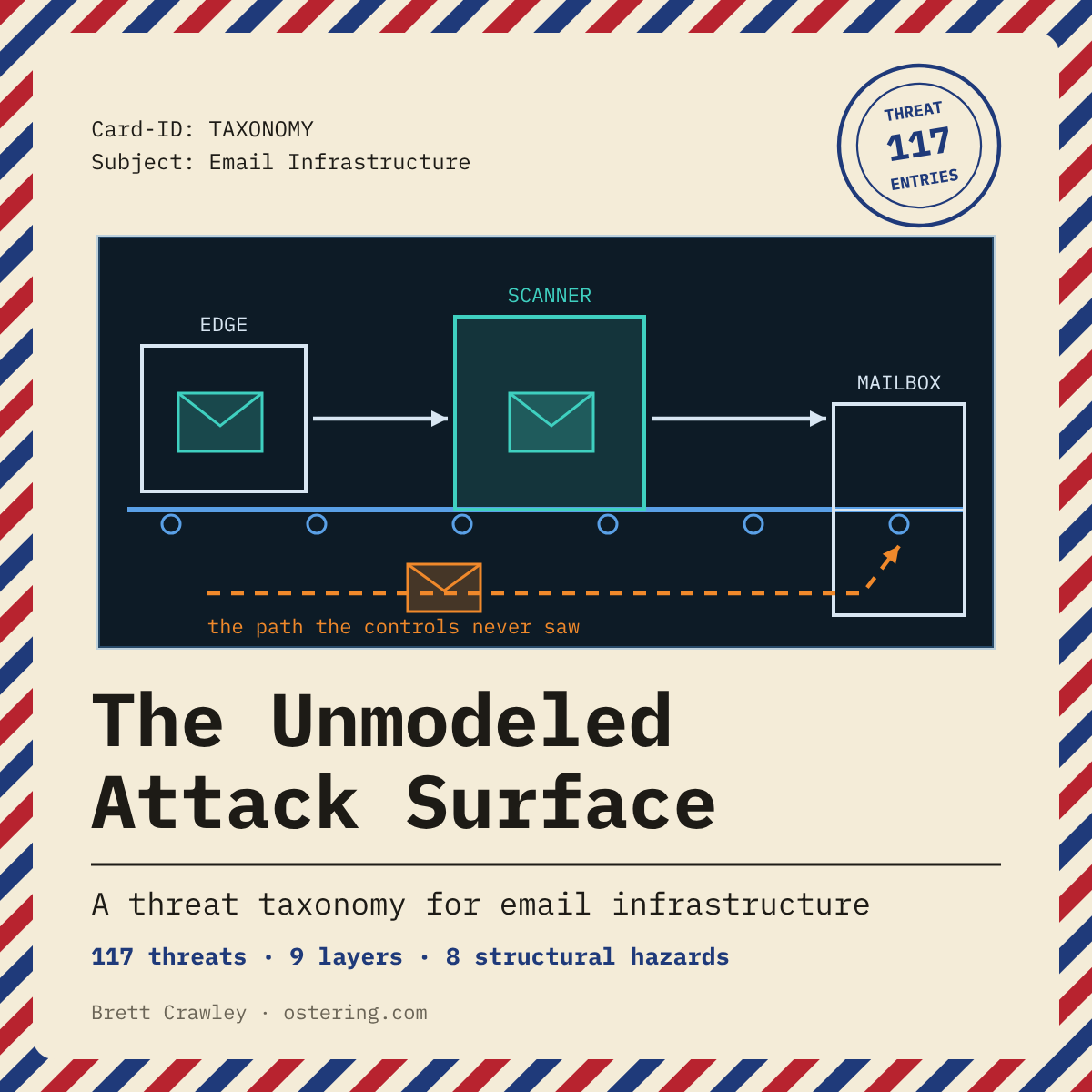
TL;DR: Email infrastructure has never had a threat taxonomy of its own. I have published one: 119 threats across nine layers of the email stack, plus twelve structural hazards, each with a mitigation principle and concrete design measures. It is the reference for my card game Elevation of Email Flow. Walk it against a mail flow you know and tell me what it misses. The full taxonomy, with a page per layer and downloads in four formats, is at Email Infrastructure Threat Taxonomy.
There is a category of infrastructure that security teams use every day, threat model with whatever tools they have to hand, and still miss a whole class of risk. It carries credentials, payment instructions, legal notices and password resets. It is the most impersonated channel in enterprise security. And the taxonomies we use to model it were built for something else.
I am talking about email. Not the phishing lure and not the malicious attachment, but the machinery itself. There is no adequate threat taxonomy for it. Nothing that covers how a Simple Mail Transfer Protocol (SMTP) conversation establishes and betrays trust. Nothing that covers how a MIME parser can be confused into rendering something the scanner never saw. Nothing that covers how SPF, DKIM and DMARC can be weaponised, not merely bypassed, or how the hops in a delivery pipeline can be pulled apart so that controls fire in the wrong order, on the wrong version of a message, or not at all.
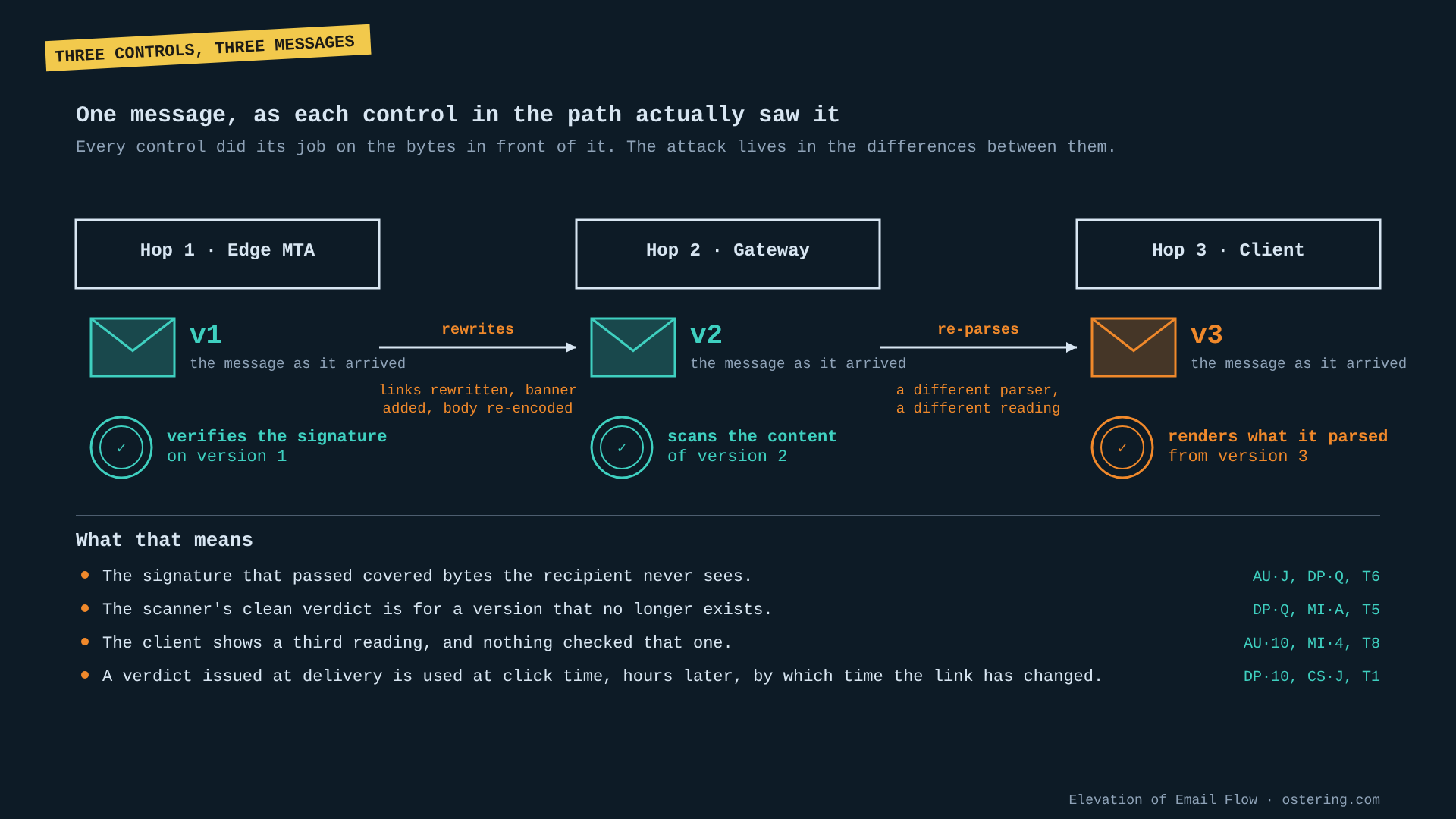
The problem is not that teams skip threat modeling. The problem is that the frameworks were not built for this domain. Apply STRIDE to email infrastructure and it will surface something. It will not surface these things.
I have published a taxonomy that does: 119 threats across nine layers of the email stack, plus twelve structural hazards, each with the principle a sound design follows and concrete measures that put it into practice. It has a home of its own on this site, with a page for every layer, and this post explains why it exists and what it covers. It is the reference for a card game I designed first, Elevation of Email Flow: every entry is one of the game’s cards, restated as prose.
Why the gap exists
Threat modeling methodology follows builders. STRIDE, PASTA and LINDDUN were shaped by the technologies that large, open communities were building on: web applications, cloud APIs, databases, identity systems. Those attracted developers. Developers attracted tooling, tooling attracted CVEs, and CVEs attracted threat models.
Email infrastructure attracted none of that. The vendor space is small and largely closed, and an MTA, a gateway or a scanner cannot be extended the way a web framework can: there is no equivalent of dropping a middleware into the delivery pipeline. Researchers do not gravitate towards what they cannot extend. So the protocols underneath every enterprise mail flow (SMTP, IMAP, POP, MIME, S/MIME, SPF, DKIM, DMARC, DNSSEC, ARC) have accumulated decades of complexity, trust assumptions and known but unmodeled failure modes, with no structured framework to surface them.
The result is not that email infrastructure is insecure by intention. It is unexamined by default. The people who build mail transfer agents (MTAs), gateways, content scanners, mailbox services and clients are very good at what they build. What they rarely have is a framework for asking: what can go wrong in this component, at this trust boundary, in this sequence?
When the framework does not exist, the question does not get asked systematically. And when the question does not get asked, the findings do not get made.
What the taxonomy is
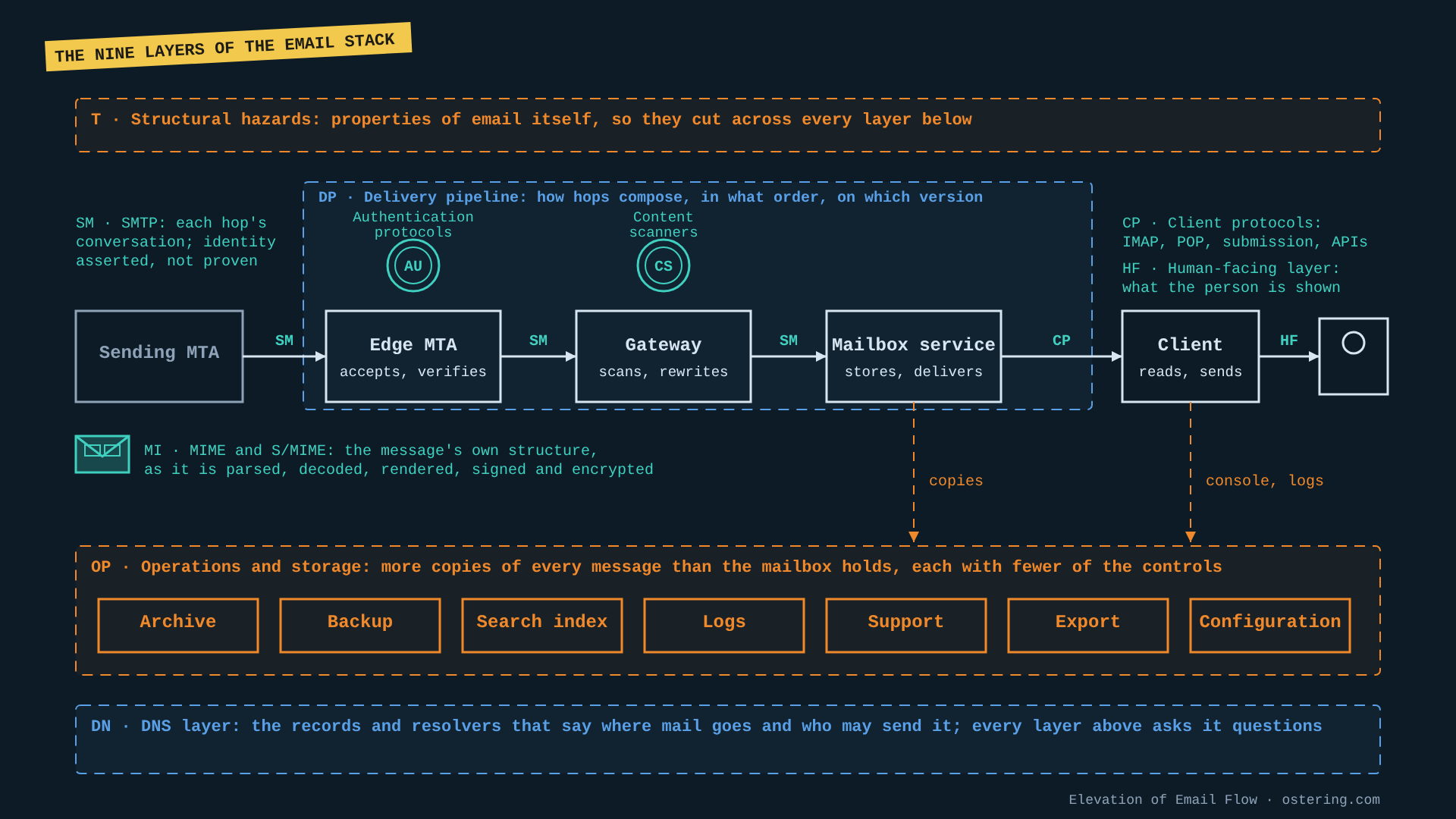
It is a structured catalogue of what can go wrong in email infrastructure, organised by the layer of the stack where the threat lives. There are nine layers, and a tenth group of structural hazards that belong to email itself and that no single component can fix.
Every entry has the same parts:
- A name, short enough to say in a design review.
- A threat, stated as a property of a component or a design decision. Not “an attacker could”, but “the platform does”.
- A mitigation principle: what a sound design does, stated so that different designs can satisfy it in different ways.
- Design measures: two to four concrete ways of satisfying the principle. They are examples of what works, not the only acceptable answers. The format is deliberate. A threat on its own is an accusation, and a list of measures on its own is a checklist that fits one architecture and no other. The principle sits between them: it says what must be true, and the measures show what that looks like in practice. Against a real design, each entry produces a finding, or a one-line “no exposure” with the reason, which is worth writing down too.
What the taxonomy assumes. It maps email as it is deployed: a message passes through a sequence of components, and every control in that sequence works by reading the message. That reader at every hop is the terrain, not a choice any one platform made, and most of the entries harden the readers rather than question them. EM-T9, The Reader in the Middle, is where the assumption itself is treated as the hazard: it asks where plaintext exists, who can read it, and whether each control could work on less. EM-T3, EM-T4 and EM-T7 are consequences of it, and EM-MI-9, EM-OP-A and EM-OP-7 point back to it. A reviewer of the first version made the point that the taxonomy named the symptoms and not the fact beneath them; EM-T9 is the response.
Each entry carries a reference such as EM-DP-J or EM-T2: EM for this taxonomy, then the layer prefix and a playing-card rank, from Ace down to 2, or T1 to T11 for the structural hazards. A point, as in EM-OP-10.1 or EM-T2.1, marks a sub-entry of the entry above it, added after the first edition; in the game it is a card that ranks just below its parent. The EM prefix keeps references from different taxonomies apart, and the dashes keep a reference in one piece when a search engine, a spreadsheet or a tool indexes it. The taxonomy is the reference for the card game Elevation of Email Flow: each entry is one of its cards, and the card carries the same reference. The reference is a stable identifier, not a severity. In the game the ranks follow severity, because play is trick-based; here a reference only names an entry, and it stays the same as the taxonomy grows.
Who it is for and how to use it
If you build a mail platform, whether an MTA, a gateway, a content scanner, a mailbox service or a client, this was written for you first. You do not need a security background. Each entry tells you what to look for, what a sound design does about it, and concrete ways that has been done.
If you are a security engineer who has been handed email infrastructure to threat model and found that STRIDE gives you the obvious but misses the specific (the pipeline fracture, the inherited verdict, the verdict that decays after delivery), this names what you have been trying to name. The layers match the way you already think, and the entries are precise enough to write findings against.
If you are a CISO, there is one question here for you. Has anyone ever threat modeled your email infrastructure against the machinery itself, and not just against what it is supposed to catch?
Using it is simple:
- Draw the mail flow: every hop, scanner, store and client a message touches, with the trust boundaries marked.
- Take one layer and walk every entry in it against each element it applies to.
- For each entry, ask whether the design satisfies the principle. Write down a finding, or “no exposure” and the design decision that defeats it.
- Where there is a finding, start from the measures given and adapt them to your architecture. They are the shape of a fix, not a prescription.
- Finish with the structural hazards, played against the design as a whole. They usually explain several findings at once and point to an architectural change, not a patch per finding. Note to platform builders: start with the delivery pipeline. Every other layer assumes the message actually passed the controls, and that is the assumption to test first.
Scope and origin
The taxonomy does not cover social engineering, phishing lures or the human decisions that make email such a successful attack vector. Those threats are real, well documented and served by existing frameworks. It covers the infrastructure: the components, protocols and sequencing contracts that deliver the message. That layer had no dedicated taxonomy.
It started as a game. I designed Elevation of Email Flow, a threat modeling card game, because I saw a gap in the games we already have: they cover web applications, cloud, privacy and more, but none of them covers email infrastructure. The deck came first, and this taxonomy is its reference: each card’s threat became an entry, each card’s suit became a layer, and the mitigation principle and measures were written to answer the questions the card asks. What you are reading is the game’s content, restated so that it can be used without the game.
I want to be clear about one thing: it is not that these issues did not exist. They were already known, publicly disclosed in real systems. SMTP smuggling, EFAIL, the composition attacks on sender authentication and the large-scale spoofing studies are well-known examples; the references at the end point to the original disclosures. What was missing was the translation. Each issue had to be restated as a threat that a designer can test their own system against, and the whole lot collated into a single resource. That is the contribution here: the translation and the collection, not the discovery.
What the taxonomy covers
The full taxonomy lives in the Email Infrastructure Threat Taxonomy section of this site, with a page for every layer. Each layer page has its entries, where it touches the other layers, and how it maps to STRIDE, CAPEC and CWE. These are the nine layers and the structural hazards:
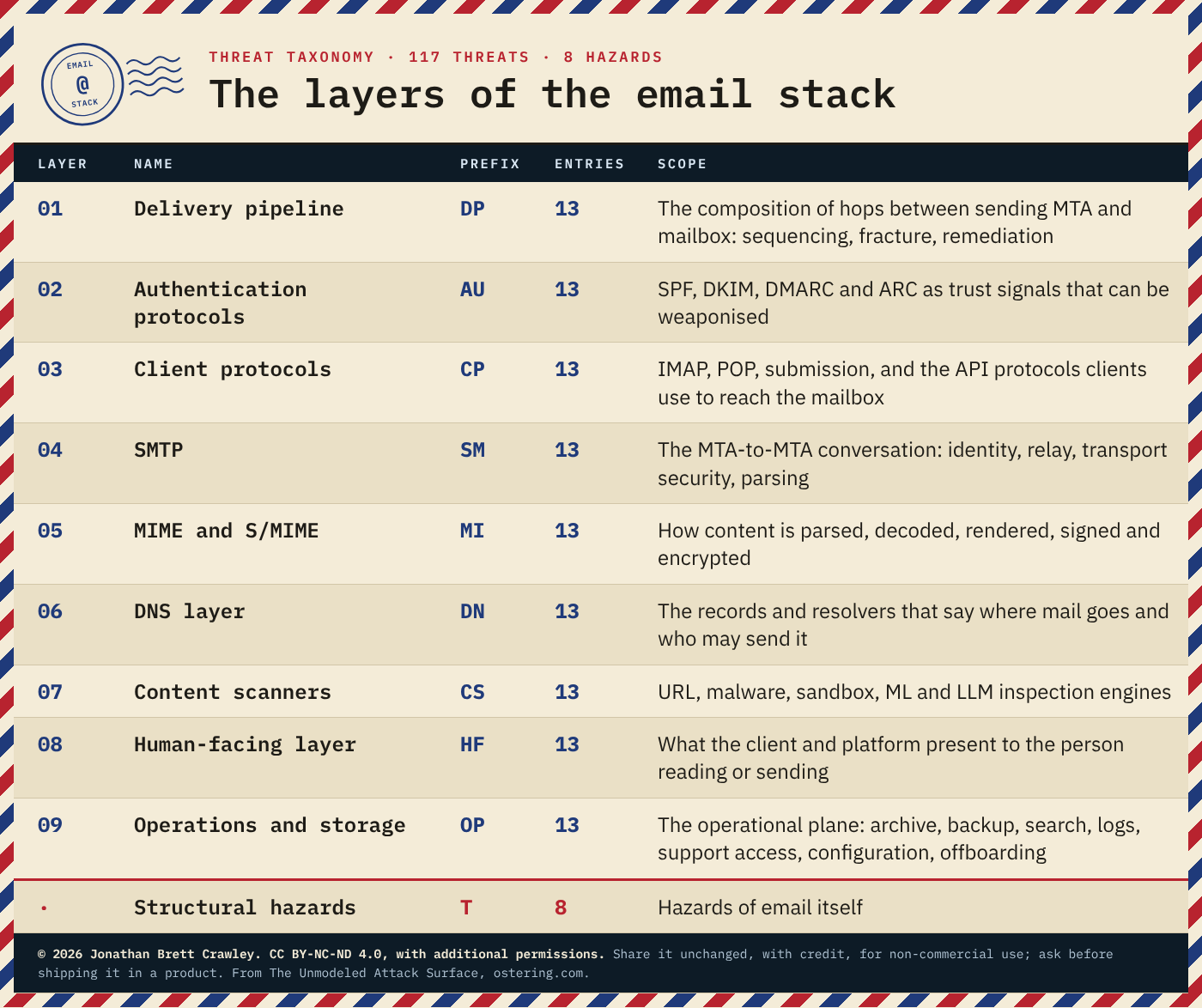
01 · Delivery pipeline (DP): 13 threats. The composition of hops between sending MTA and mailbox: sequencing, fracture, remediation.
02 · Authentication protocols (AU): 13 threats. SPF, DKIM, DMARC and ARC as trust signals that can be weaponised.
03 · Client protocols (CP): 13 threats. IMAP, POP, submission, and the API protocols clients use to reach the mailbox.
04 · SMTP (SM): 13 threats. The MTA-to-MTA conversation: identity, relay, transport security, parsing.
05 · MIME and S/MIME (MI): 13 threats. How content is parsed, decoded, rendered, signed and encrypted.
06 · DNS layer (DN): 13 threats. The records and resolvers that say where mail goes and who may send it.
07 · Content scanners (CS): 13 threats. URL, malware, sandbox, ML and LLM inspection engines.
08 · Human-facing layer (HF): 13 threats. What the client and platform present to the person reading or sending.
09 · Operations and storage (OP): 15 threats. The operational plane: archive, backup, search, logs, support access, configuration, offboarding. The whole stack
Structural hazards (T): 12 hazards. Hazards of email itself. That is 119 threats and twelve structural hazards in all. The overview page also covers where the layers touch, the original disclosures behind the entries, the licence and the version history.
Final thoughts
This is a first published version, not a final one. The domain is complex, the vendor space is not standing still, and I have no doubt there are threats I have missed and entries that belong in a different layer.
So take it, walk a layer against a mail flow you know well, and tell me where it falls short. Corrections, missing threats and worked examples from practitioners are all welcome: reach out to me on LinkedIn.
Email has gone unexamined by default for long enough. Let’s start asking the question. More on the game the taxonomy came from in a later post. Stay tuned!
Update, 6 November 2026. A reviewer of the first version pointed out that EM-T3, EM-T4 and EM-T7 describe symptoms of a hazard the taxonomy never named: every control in a mail flow works by reading the message, so the reader at every hop is both the control and the exposure. EM-T9, The Reader in the Middle, is the response, and EM-MI-9, EM-OP-A, EM-OP-7, EM-T3, EM-T4 and EM-T7 now point to it. The card came first, as with the rest of the deck. The taxonomy pages, the mapping post and the four downloads are at version 1.3.
Update, 14 November 2026. The Exchange Online outage of 12 to 14 November showed a family the taxonomy did not have: what happens to mail when the platform says no. Five entries are added. Two are hazards of email itself and go to the Trumps: EM-T11 Delay Becomes Loss, now the high Trump, and EM-T10 Suppression After Outage; EM-T2.1 Shared Infrastructure, Shared Outage sits under EM-T2. Two are the platform’s own operational decisions and go where they belong, in operations and storage, as sub-entries below their parents: EM-OP-10.1 False Rejection under Unreviewed Configuration Change and EM-OP-5.1 Control-Plane Blackout under Audit Gap. A point in a reference marks a sub-entry, and a layer is no longer a fixed thirteen. A reviewer of the first draft of this update made two points that are now in the text: the Trumps were filling up because the layers were full, and the usual fix for Delay Becomes Loss, a gateway that spools inbound mail for days, is itself EM-T9. None of the five has a CAPEC pattern: a catalogue of attack patterns has nothing to say about a platform refusing mail. Taxonomy version 1.5; 131 entries, 119 in the layers and twelve hazards.
Resources
The taxonomy is also available to download in four formats, all with the licence embedded. The overview page lists them too.
| Download | Format | What it is for |
|---|---|---|
| A4 landscape, a section per layer, with each entry’s mappings | Reading and printing | |
| Excel | One layer per sheet, with the STRIDE, CAPEC and CWE mappings | Filtering, sorting, and tracking findings against each entry |
| SKOS (JSON-LD) | W3C SKOS concept scheme | Linked data and knowledge graphs |
| STIX 2.1 | STIX 2.1 bundle | Threat intelligence and security tools |
Licence
© 2026 Jonathan Brett Crawley. The taxonomy is licensed under CC BY-NC-ND 4.0 with additional permissions: you can share it freely for non-commercial purposes, threat model with it (including for paying clients), use it internally and for training in any organisation, and quote entries with credit in paid work. Shipping it in a product needs permission. The full terms are on the overview page.
References
- Timo Longin, SEC Consult Vulnerability Lab, SMTP Smuggling: Spoofing E-Mails Worldwide, 18 December 2023.
- Damian Poddebniak, Christian Dresen, Jens Müller, Fabian Ising, Sebastian Schinzel, Simon Friedberger, Juraj Somorovsky and Jörg Schwenk, Efail: Breaking S/MIME and OpenPGP Email Encryption using Exfiltration Channels, 27th USENIX Security Symposium, 2018.
- Jianjun Chen, Vern Paxson and Jian Jiang, Composition Kills: A Case Study of Email Sender Authentication, 29th USENIX Security Symposium, 2020.
- Kaiwen Shen, Chuhan Wang, Minglei Guo, Xiaofeng Zheng, Chaoyi Lu, Baojun Liu, Yuxuan Zhao, Shuang Hao, Haixin Duan, Qingfeng Pan and Min Yang, Weak Links in Authentication Chains: A Large-scale Analysis of Email Sender Spoofing Attacks, 30th USENIX Security Symposium, 2021.
You may also like:

Elevation of Email Flow Launch
Threat modeling the machinery that delivers email TL;DR:...

AI Assisted Threat Modeling
The Threat Model Was Never the Point: What...

Threat Modeling MCP
Threat Modeling the Model Context Protocol: Your Agent...

Threat Modeling AI Systems: A Complete Playbook for Practitioners
The Blast Radius - Edition [4] Over the...