Operations and storage (OP)
Taxonomies › Email infrastructure › Operations and storage
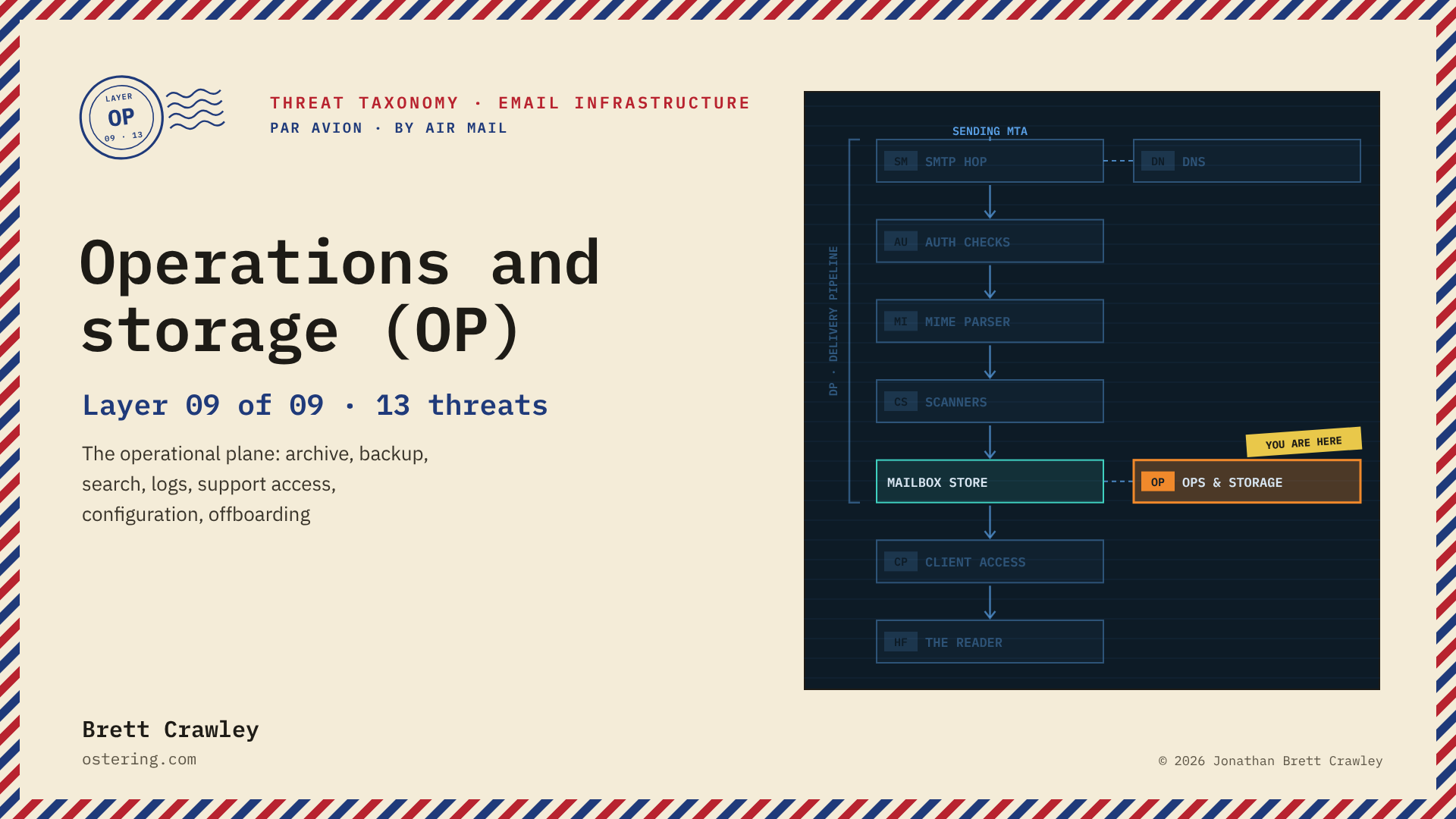
Layer 09 of 09 · 15 threats · prefix OP
The operational plane holds more copies of every message than the mailbox store does, each under a weaker access model. These entries cover archive, backup, search and logs, support and export tooling, configuration, credentials and offboarding. Two entries sit directly below their parents: EM-OP-10.1 is what an unreviewed change does to legitimate mail, EM-OP-5.1 what an outage does to the console. A point in a reference marks a sub-entry of the entry above it; in the game it is a card that ranks just below its parent.
Scope: The operational plane: archive, backup, search, logs, support access, configuration, offboarding.
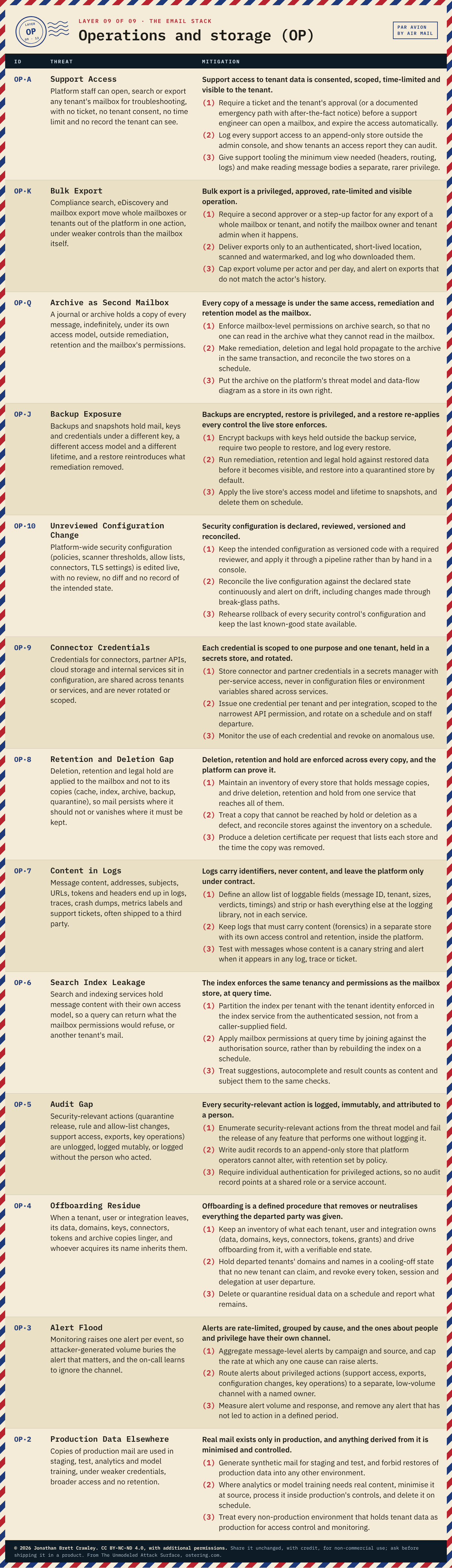
Text version: every entry on this page is in the PDF and Excel downloads on the overview page, where it can be searched and copied.
The threats
- EM-OP-A Support Access
- EM-OP-K Bulk Export
- EM-OP-Q Archive as Second Mailbox
- EM-OP-J Backup Exposure
- EM-OP-10 Unreviewed Configuration Change
- EM-OP-10.1 False Rejection
- EM-OP-9 Connector Credentials
- EM-OP-8 Retention and Deletion Gap
- EM-OP-7 Content in Logs
- EM-OP-6 Search Index Leakage
- EM-OP-5 Audit Gap
- EM-OP-5.1 Control-Plane Blackout
- EM-OP-4 Offboarding Residue
- EM-OP-3 Alert Flood
- EM-OP-2 Production Data Elsewhere
Where this layer touches others
- Availability: What happens when the platform says no is split by who owns the decision. Delay Becomes Loss (EM-T11) and Suppression After Outage (EM-T10) are hazards: they sit on the sender’s queue and the sender’s suppression list, which the receiver does not own. False Rejection (EM-OP-10.1) and Control-Plane Blackout (EM-OP-5.1) are the platform’s own operational decisions, a change that goes live unreviewed and a console that shares fate with the data plane, so they sit under their parents in operations and storage. Shared Infrastructure, Shared Outage (EM-T2.1) is the pipeline’s concentration (EM-DP-2, EM-DP-6). Resource Exhaustion (EM-SM-6) is the effect each of them produces.
- Readers: MIME and S/MIME (EM-MI-9), the content scanner layer and operations and storage (EM-OP-A, EM-OP-7, EM-OP-Q, EM-OP-6) each assume a component that holds plaintext. The Reader in the Middle (EM-T9) is the structural hazard behind all of them: the control and the exposure are the same component.
- Operations and the other layers: delivery pipeline, client protocols and DNS each cover a corner of operations (admin routing changes in EM-DP-2, mailbox state in EM-CP-10, dangling records in EM-DN-K). Operations and storage covers the stores and tooling around the message path: the copies, the credentials and the people with access.
STRIDE, CAPEC and CWE
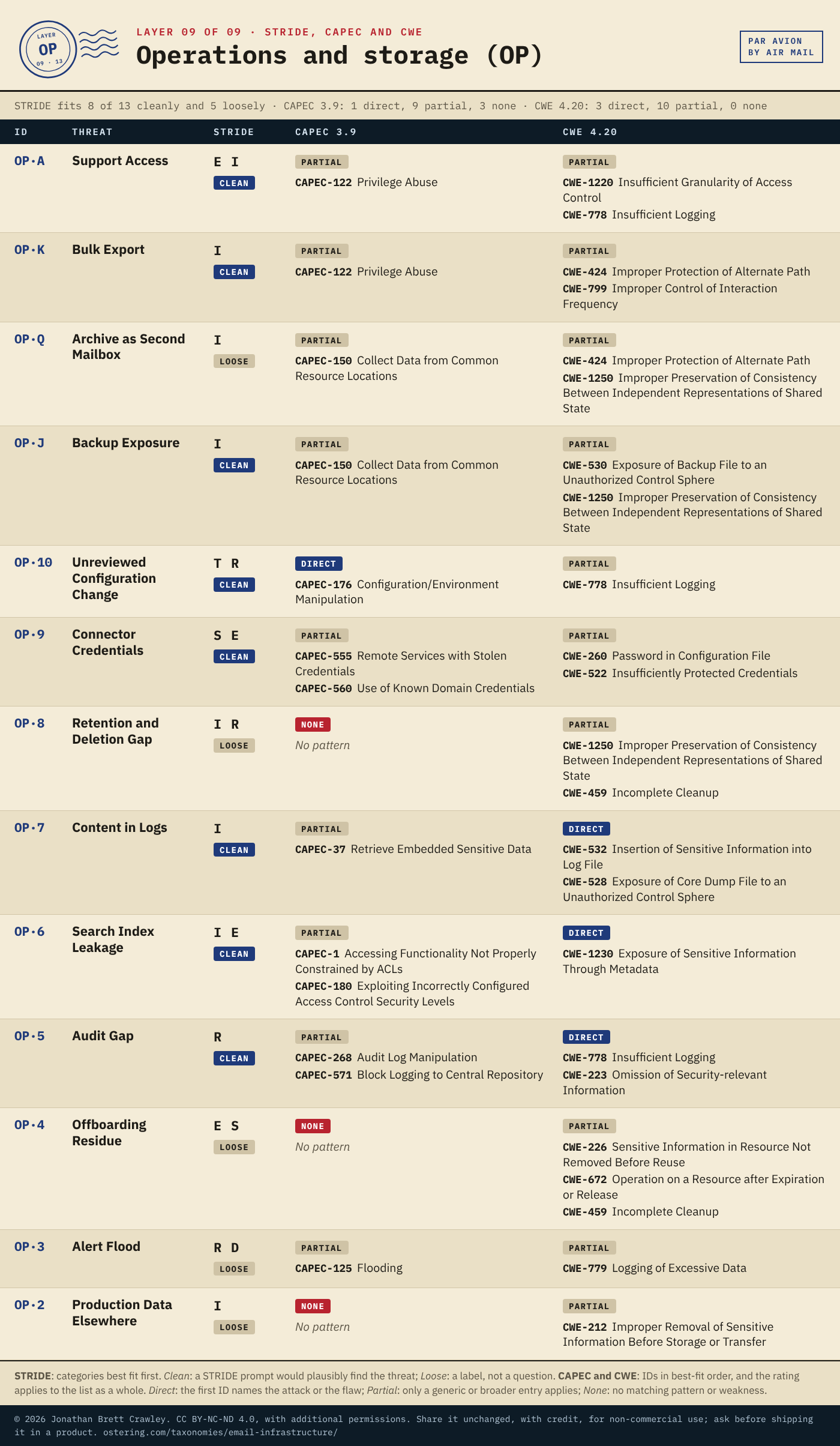
Of the 15 entries here, STRIDE fits 8 cleanly and 7 only loosely. CAPEC 3.9 has a pattern that describes 1 of them directly, only a generic parent pattern for 9, and nothing for 5. CWE 4.20 names the weakness directly for 3, has only a broader weakness for 11, and nothing for 1. The table below gives the mapping entry by entry, with the names of the CAPEC patterns and CWE weaknesses; what the mapping shows across the whole taxonomy is in Mapping the Email Threat Taxonomy to STRIDE, CAPEC and CWE. The Excel, SKOS and STIX downloads carry the same mapping as text.
← Human-facing layer (HF) · Email infrastructure overview · Structural hazards (T) →
© 2026 Jonathan Brett Crawley. Licensed under CC BY-NC-ND 4.0 with additional permissions: see the licence on the email infrastructure overview.