Human-facing layer (HF)
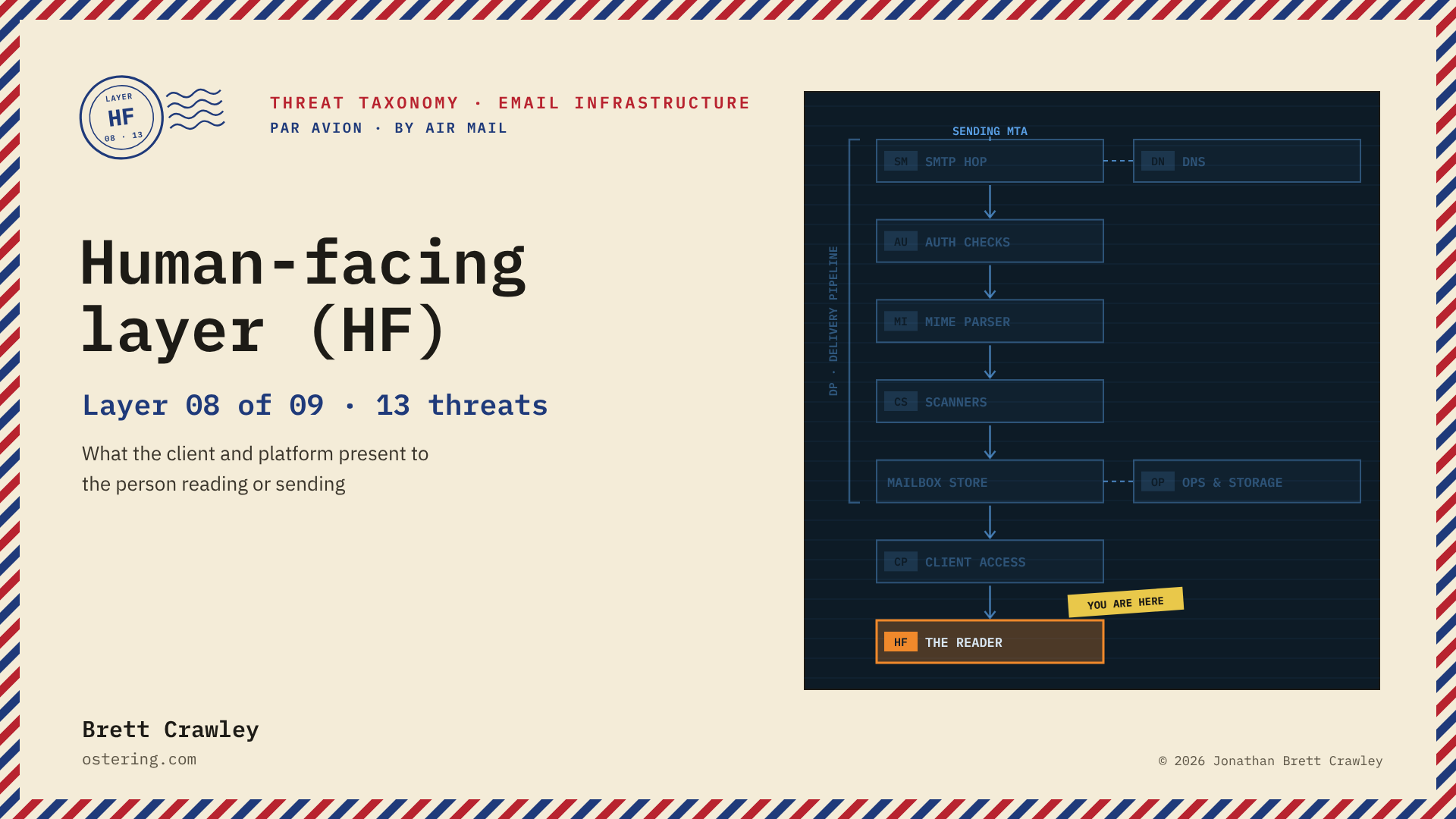
Taxonomies › Email infrastructure › Human-facing layer
Layer 08 of 09 · 13 threats · prefix HF
The interface decides which facts about a message a person sees before they act on it. These entries cover what the client and the platform present, and the decisions the design leaves to the user.
Scope: What the client and platform present to the person reading or sending.
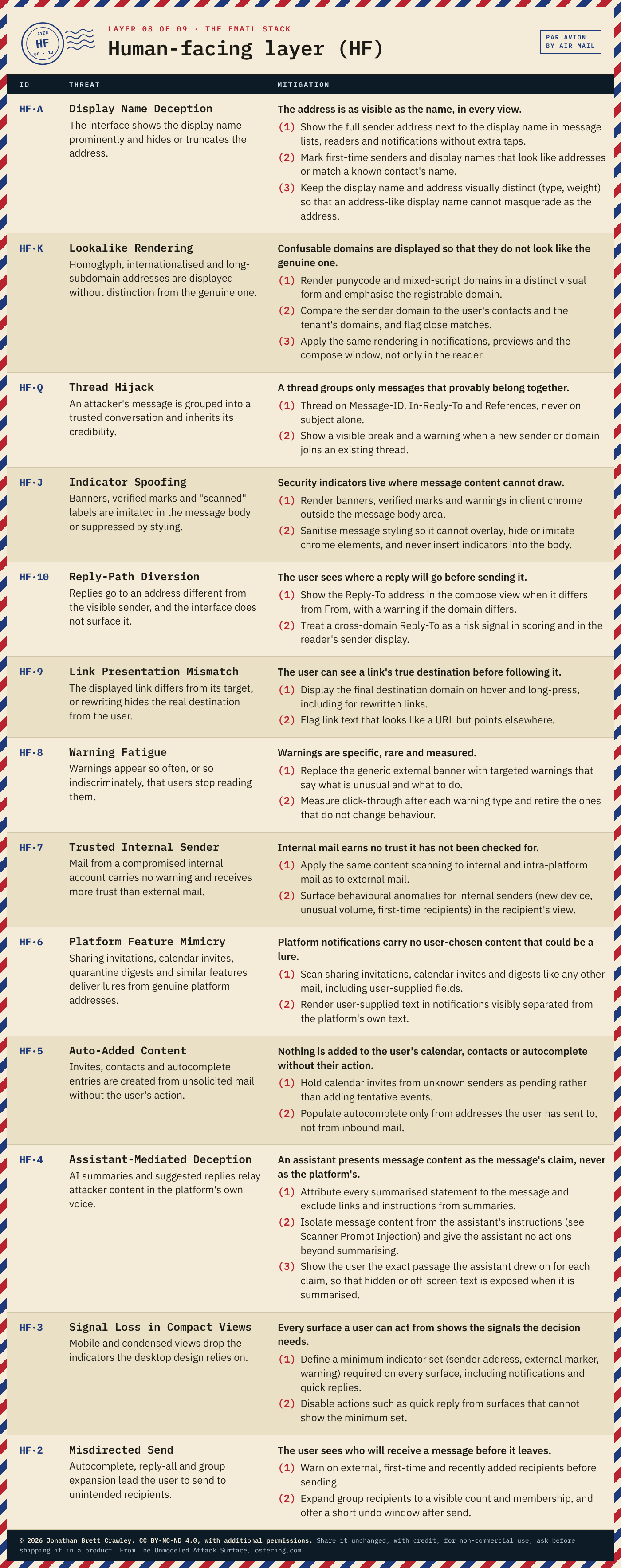
Text version: every entry on this page is in the PDF and Excel downloads on the overview page, where it can be searched and copied.
The threats
- HF·A Display Name Deception
- HF·K Lookalike Rendering
- HF·Q Thread Hijack
- HF·J Indicator Spoofing
- HF·10 Reply-Path Diversion
- HF·9 Link Presentation Mismatch
- HF·8 Warning Fatigue
- HF·7 Trusted Internal Sender
- HF·6 Platform Feature Mimicry
- HF·5 Auto-Added Content
- HF·4 Assistant-Mediated Deception
- HF·3 Signal Loss in Compact Views
- HF·2 Misdirected Send
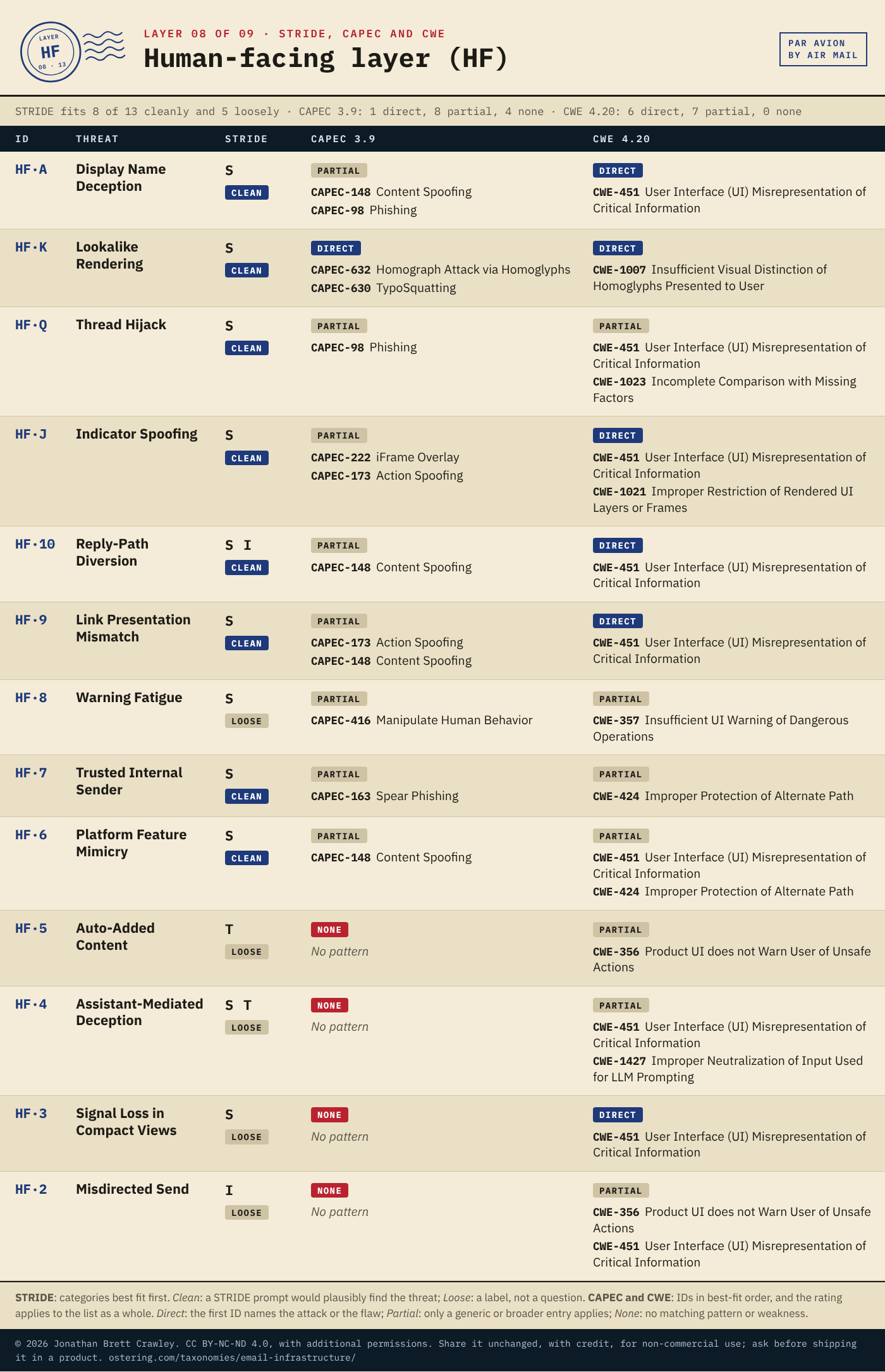
STRIDE, CAPEC and CWE
Of the 13 entries here, STRIDE fits 8 cleanly and 5 only loosely. CAPEC 3.9 has a pattern that describes 1 of them directly, only a generic parent pattern for 8, and nothing for 4. CWE 4.20 names the weakness directly for 6, has only a broader weakness for 7,. The table below gives the mapping entry by entry, with the names of the CAPEC patterns and CWE weaknesses; what the mapping shows across the whole taxonomy is in Mapping the Email Threat Taxonomy to STRIDE, CAPEC and CWE. The Excel, SKOS and STIX downloads carry the same mapping as text.
← Content scanners (CS) · Email infrastructure overview · Operations and storage (OP) →
© 2026 Jonathan Brett Crawley. Licensed under CC BY-NC-ND 4.0 with additional permissions: see the licence on the email infrastructure overview.