Critical Infrastructure (Cyberwarfare) Threat Taxonomy
Taxonomies › Critical Infrastructure
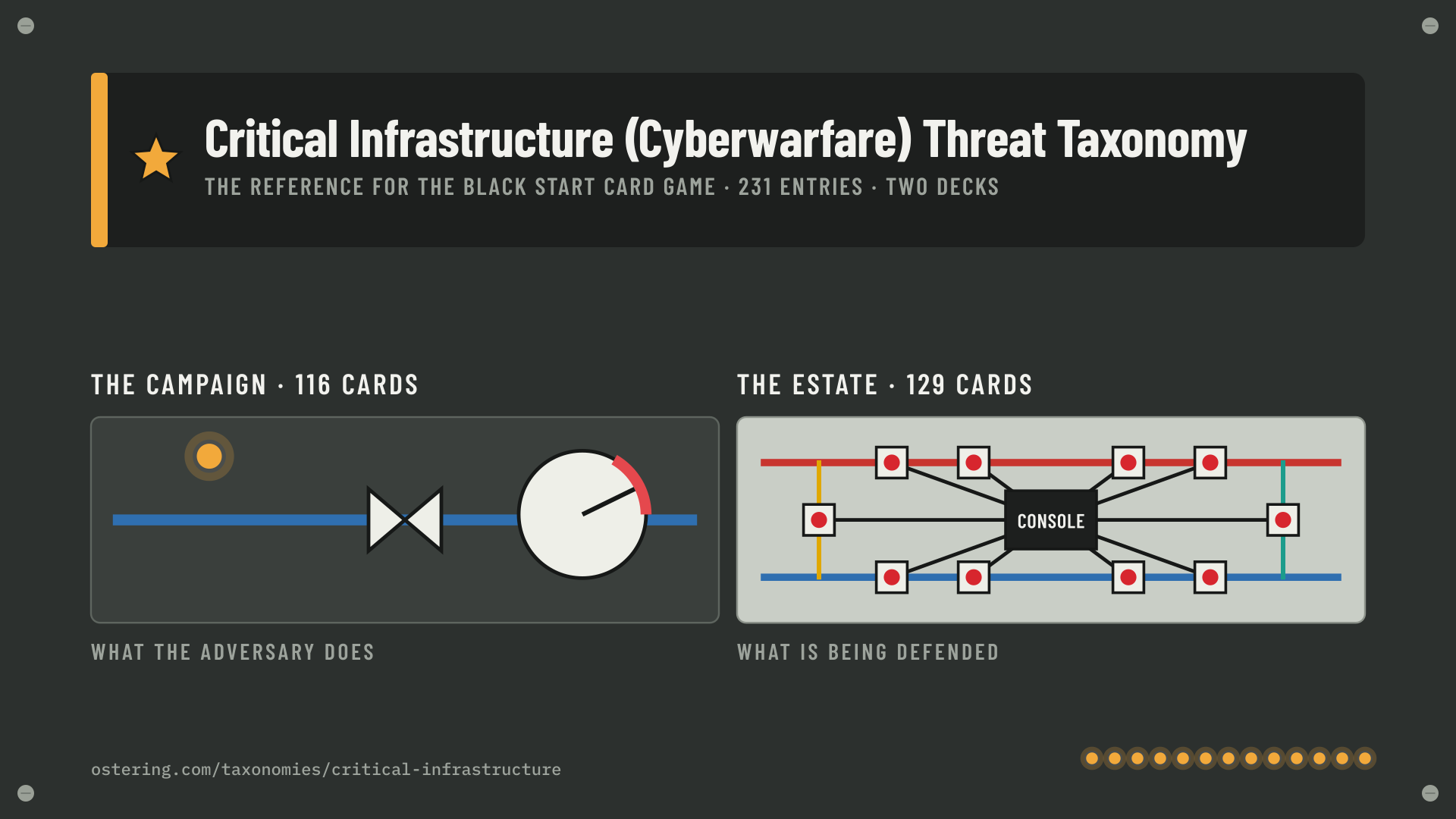
This is the reference for the Black Start card game: every card’s threat, the mitigation principle a sound design follows, design measures, and mappings to STRIDE, CAPEC, CWE, MITRE ATT&CK for ICS and the Cyber-Informed Engineering principles.
It covers the systems that keep a country fed, watered, heated, moving and paid: food retail and the cold chain, water and wastewater, electricity, gas, fuel, transport and logistics, payments, and the platforms that run them remotely. It is written for the people who design, buy, integrate and operate those systems, and it is jurisdiction-neutral.
The adversary is a state, or acting for one. It is patient and well resourced, and it wants an effect: disruption, destruction, coercion or a loss of public confidence, not money. It prepares in peacetime, signals with limited strikes, and strikes hard in a crisis. A criminal wants one victim to pay. A state wants many sites to fail at once, at a moment it chooses, for as long as possible, and wants to deny it did it.
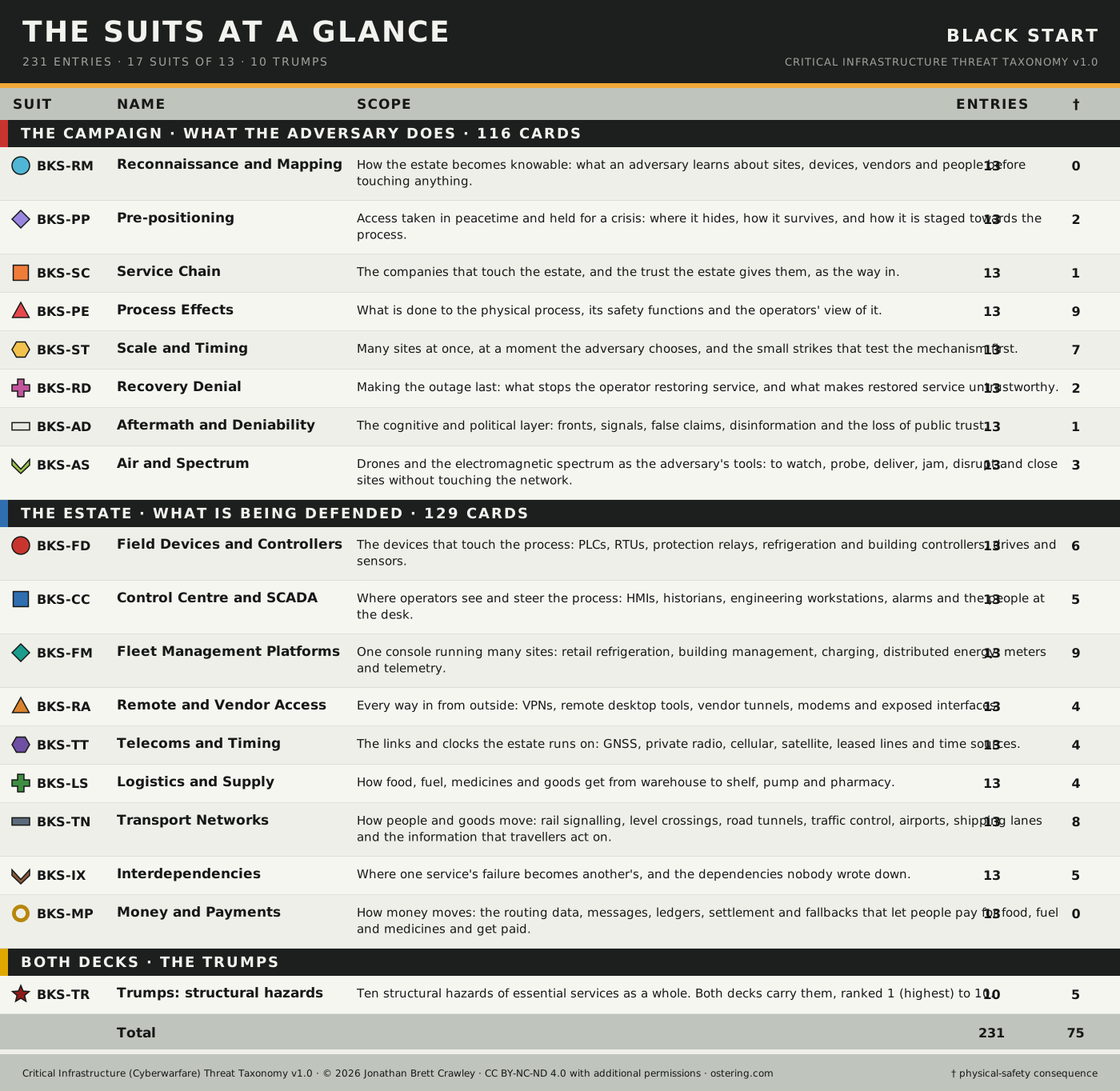
The taxonomy has 231 entries: 17 suits of 13 and 10 Trumps, the structural hazards that run through every suit. † marks an entry with a physical-safety consequence: fire, poisoning, flooding, explosion, or loss of heat, water or transport safety.
Two decks
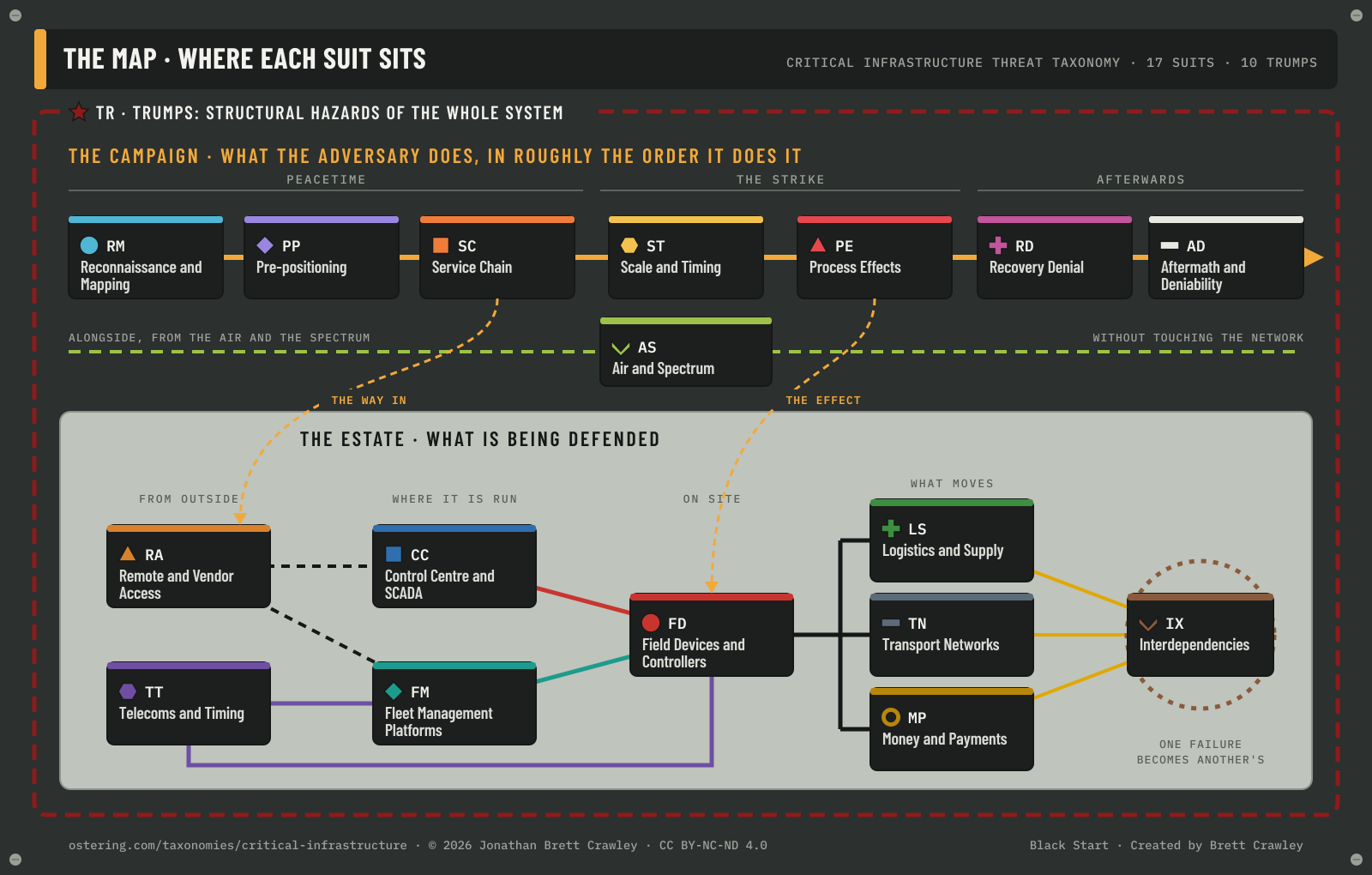
Black Start is played with two decks. The Campaign is what the adversary does; The Estate is what is being defended. Each deck plays on its own, and both carry the Trumps.
The Campaign
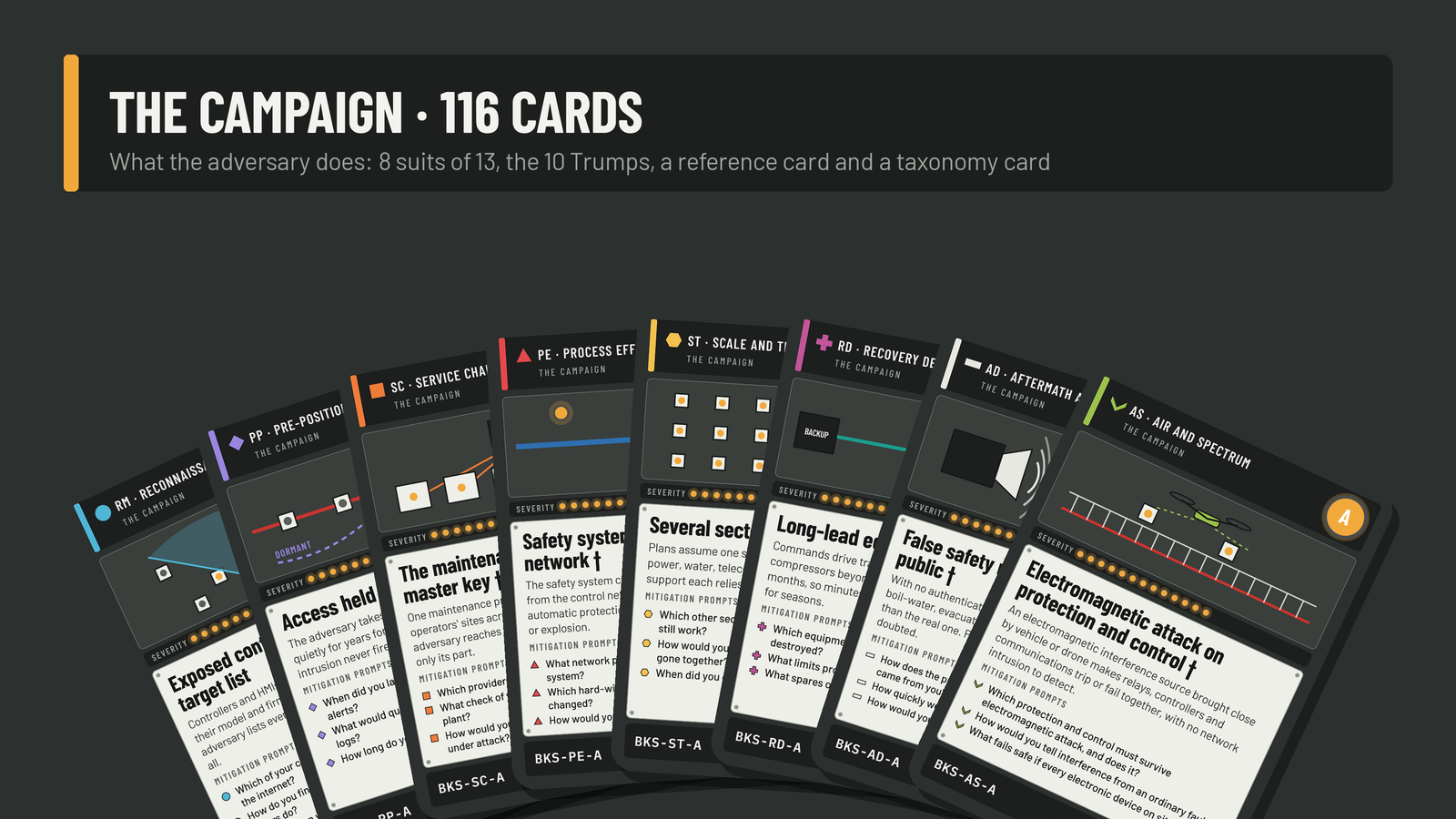
- RM · Reconnaissance and Mapping: How the estate becomes knowable: what an adversary learns about sites, devices, vendors and people before touching anything.
- PP · Pre-positioning: Access taken in peacetime and held for a crisis: where it hides, how it survives, and how it is staged towards the process.
- SC · Service Chain: The companies that touch the estate, and the trust the estate gives them, as the way in.
- PE · Process Effects: What is done to the physical process, its safety functions and the operators’ view of it.
- ST · Scale and Timing: Many sites at once, at a moment the adversary chooses, and the small strikes that test the mechanism first.
- RD · Recovery Denial: Making the outage last: what stops the operator restoring service, and what makes restored service untrustworthy.
- AD · Aftermath and Deniability: The cognitive and political layer: fronts, signals, false claims, disinformation and the loss of public trust.
- AS · Air and Spectrum: Drones and the electromagnetic spectrum as the adversary’s tools: to watch, probe, deliver, jam, disrupt and close sites without touching the network.
The Estate
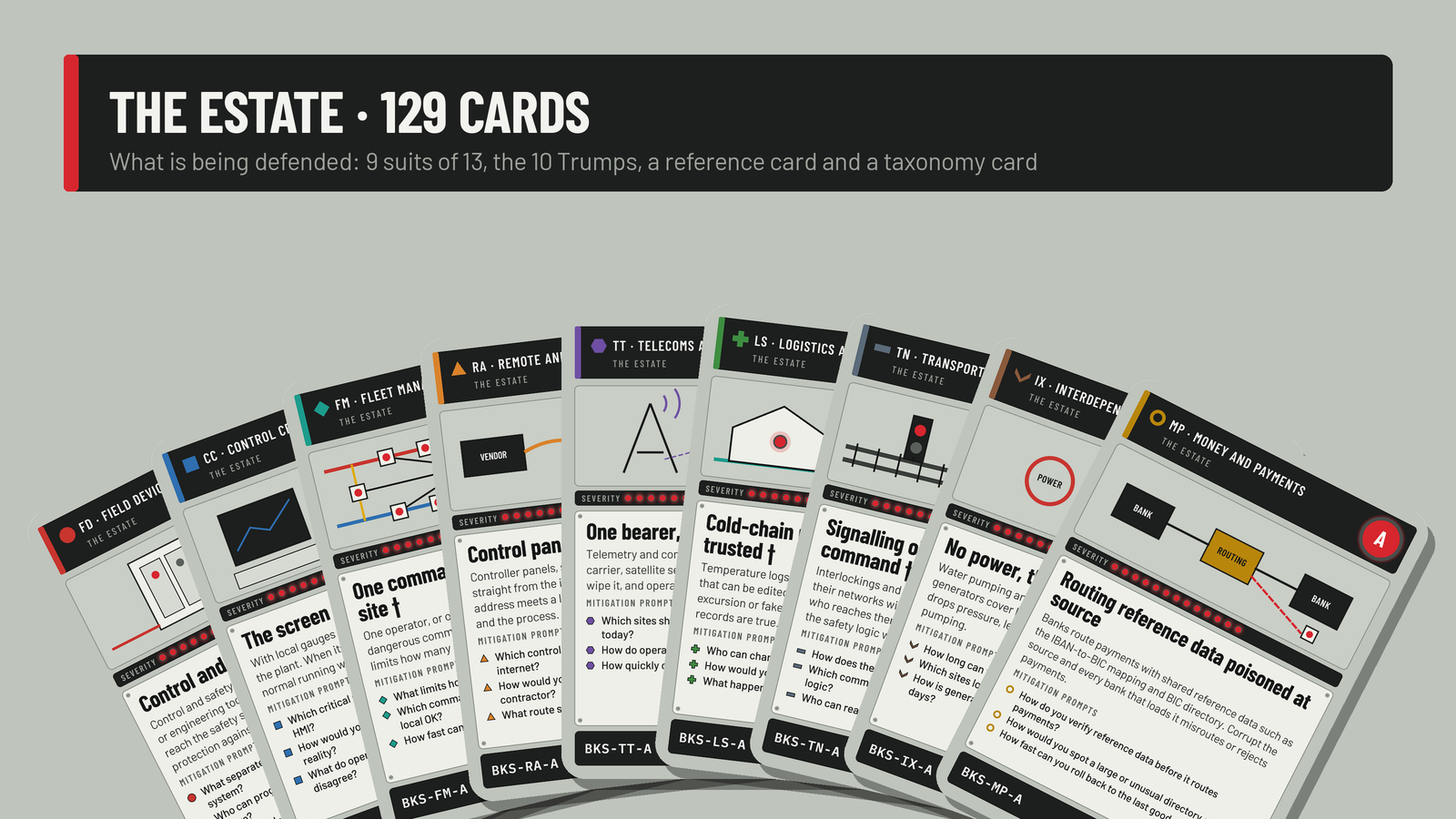
- FD · Field Devices and Controllers: The devices that touch the process: PLCs, RTUs, protection relays, refrigeration and building controllers, drives and sensors.
- CC · Control Centre and SCADA: Where operators see and steer the process: HMIs, historians, engineering workstations, alarms and the people at the desk.
- FM · Fleet Management Platforms: One console running many sites: retail refrigeration, building management, charging, distributed energy, meters and telemetry.
- RA · Remote and Vendor Access: Every way in from outside: VPNs, remote desktop tools, vendor tunnels, modems and exposed interfaces.
- TT · Telecoms and Timing: The links and clocks the estate runs on: GNSS, private radio, cellular, satellite, leased lines and time sources.
- LS · Logistics and Supply: How food, fuel, medicines and goods get from warehouse to shelf, pump and pharmacy.
- TN · Transport Networks: How people and goods move: rail signalling, level crossings, road tunnels, traffic control, airports, shipping lanes and the information that travellers act on.
- IX · Interdependencies: Where one service’s failure becomes another’s, and the dependencies nobody wrote down.
- MP · Money and Payments: How money moves: the routing data, messages, ledgers, settlement and fallbacks that let people pay for food, fuel and medicines and get paid.
Both decks
- Trumps: structural hazards: Ten structural hazards of essential services as a whole. Both decks carry them, ranked 1 (highest) to 10.
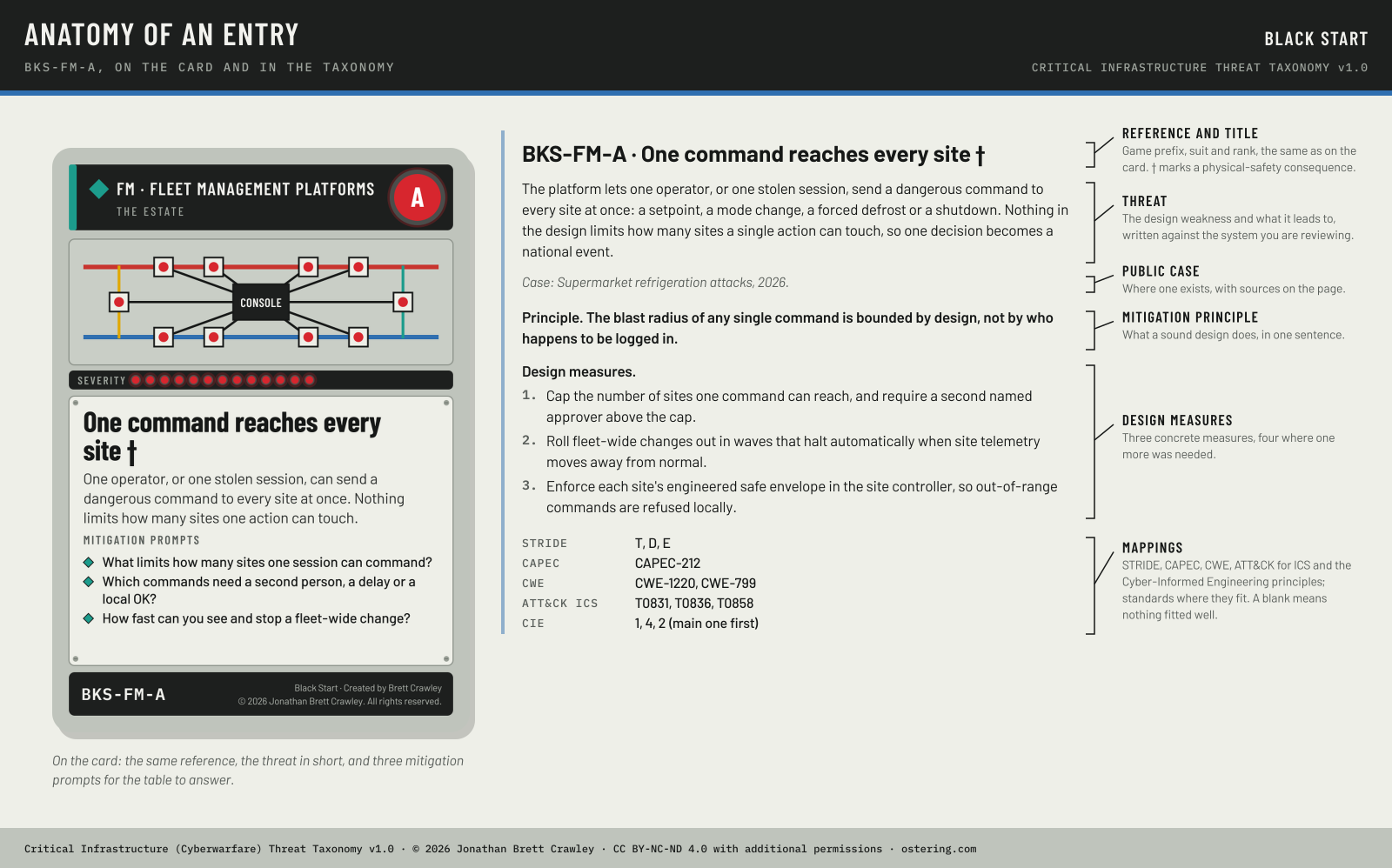
How to read an entry
- Reference: the game prefix, suit and rank joined by hyphens, for example BKS-PE-A or BKS-TR-4. It is the same reference as the card.
- Threat: the design weakness and what it leads to, written against the system you are reviewing.
- Principle and design measures: the mitigation principle a sound design follows, then three concrete measures (four where one more was needed).
- Mappings: STRIDE; CAPEC; CWE; MITRE ATT&CK for ICS; the Cyber-Informed Engineering (CIE) principles, the main one first; and, where they fit, IEC 61000-4-36 and IEC TS 61000-5-10 (intentional electromagnetic interference), CLC/TS 50701 (railway cybersecurity) and IEC 62443. A blank means nothing fitted well; a loose tag would mislead.
References
Each reference is the game prefix BKS, the suit code and a playing-card rank from Ace down to 2, or 1 to 10 for the Trumps, joined by hyphens so that the whole reference is one searchable token. In the game the ranks follow severity, because play is trick-based. Here a reference only names an entry. The ranks are frozen: an entry added later between two ranks takes an intermediate value, such as BKS-PE-3.1, so no published reference ever changes.
How the mappings were checked
Every identifier was checked against MITRE’s own data: ATT&CK for ICS from the v20.0 release (October 2026), CAPEC 3.9 and CWE 5.0 (28 October 2026). Revoked and deprecated ATT&CK and CAPEC entries were excluded, and only CWEs whose mapping usage is Allowed or Allowed-with-Review were used, so no Discouraged or Prohibited CWEs and no categories. CIE numbers follow the DOE Cyber-Informed Engineering Implementation Guide, version 1.0:
- Consequence-Focused Design
- Engineered Controls
- Secure Information Architecture
- Design Simplification
- Layered Defenses
- Active Defense
- Interdependency Evaluation
- Digital Asset Awareness
- Cyber-Secure Supply Chain Controls
- Planned Resilience
- Engineering Information Control
- Organizational Culture
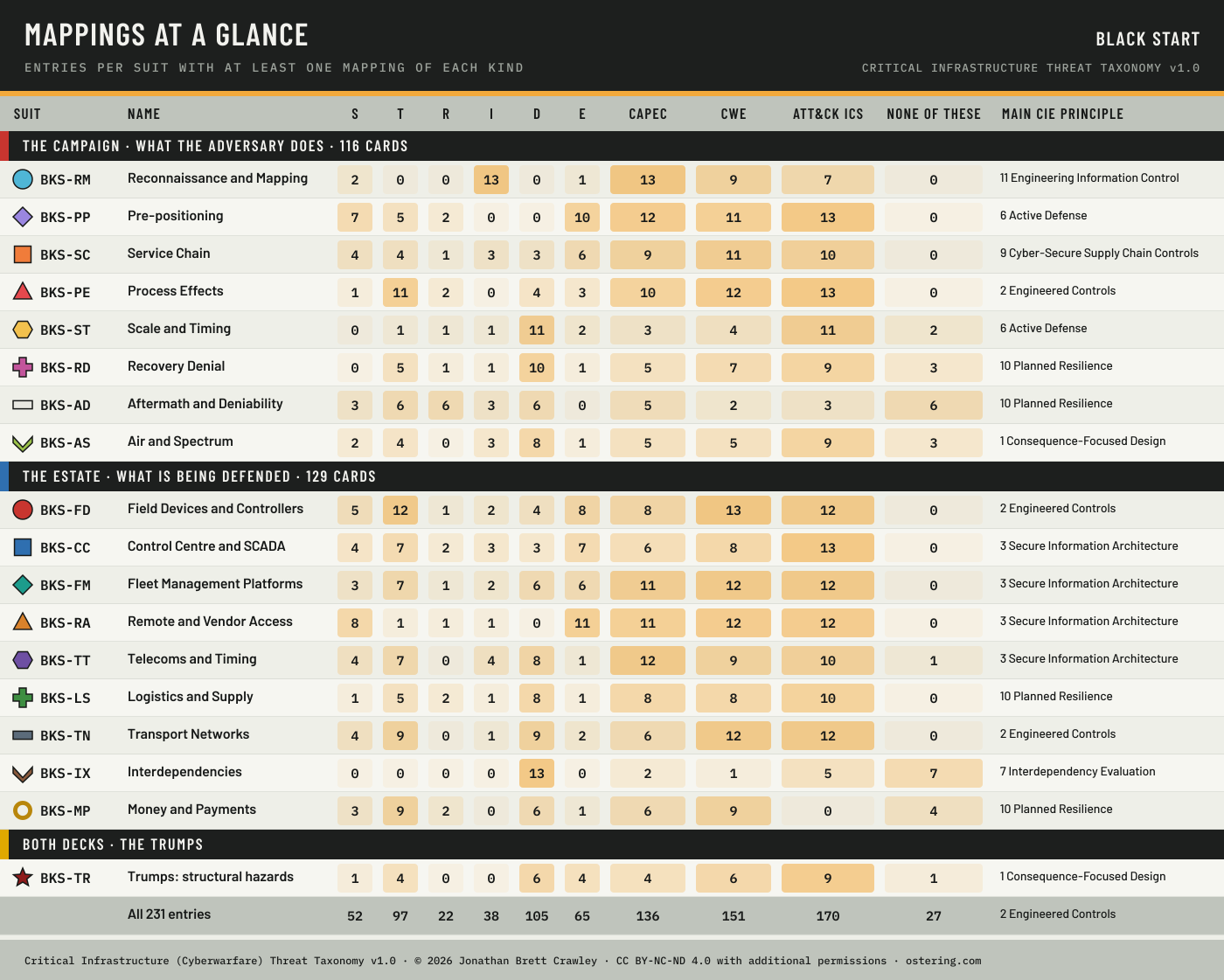
Many entries in Aftermath and Deniability, Scale and Timing, Interdependencies and Money and Payments have no CAPEC, CWE or ATT&CK for ICS mapping. That is a finding in itself: those frameworks describe techniques and weaknesses, not the campaign a state wages around them.
Scope
Home energy devices (solar inverters, home batteries, smart meters inside the home) are in the Smart Home Threat Taxonomy. The vendors’ own build and release pipelines are in the Software Factory taxonomy. AI agents in control rooms are in the AI and Agentic Systems Threat Taxonomy. This taxonomy picks those up only where they become a route into, or a consequence for, the essential service. State theft from banks and crypto platforms for revenue is out of scope; attacks on payments meant to disrupt are in Money and Payments.
Public cases
Entries cite these public cases. Each was checked against the sources listed, and attribution is given only where an official body made it or a group claimed it.
- Supermarket refrigeration attacks, 2026. Overnight on 11 to 12 October 2026 attackers forced the remote-managed refrigeration controllers of hundreds of French supermarkets into defrost, heating cabinets to as much as 50C; stock was destroyed and some equipment caught fire. CERT-FR told operators to disconnect the controllers or tightly filter access to them. A second wave on 2 November hit supermarkets and food businesses in Sweden, Belgium, Ireland, Luxembourg, Estonia and Italy, and five Danish companies, where the attacks were stopped quickly. Danfoss confirmed its products were involved, and France’s cyber agency judged the campaign probably still under way. Attribution: Unattributed at time of writing; Paris prosecutor’s investigation open. Sources: The Hacker News: attackers heat French supermarket fridges; BleepingComputer: cyberattack shuts down refrigerators at French supermarkets; DR: what we know about the attacks on European supermarkets; Today.it: attacks on refrigeration in Italy, ACN alert
- Leipzig/Halle airport drone, 2026. On the night of 4 to 5 August 2026 a drone carrying explosives was found at Leipzig/Halle airport near a Ukrainian cargo aircraft and was made safe by police; on 1 September the German government said it held Russia responsible and closed a Russian consulate. Attribution: Attributed by the German government (September 2026) to Russia. Sources: Euronews: Russia behind drone incident at Leipzig airport, Berlin says; OPB: Germany blames Russia for attempted drone attack at Leipzig airport
- Drones over Doel and Belgian airports, 2025. On the evening of 9 November 2025 drones were seen over Belgium’s Doel nuclear power plant, without affecting its operation, the same evening that drones halted traffic at Liège airport; Brussels airport and several military bases had similar incursions that month. Attribution: Unattributed; Belgian intelligence services were reported to believe a foreign state, most likely Russia, was behind the series. Sources: European Pravda: unknown drones spotted over Belgian nuclear power plant; DroneLife: drone incursions at Belgium nuclear plant
- Munich airport drones, 2025. On 2 and 3 October 2025 drone sightings closed Munich airport twice in less than 24 hours, diverting and cancelling flights; drones had also been reported over the nearby Erding air base. Attribution: Unattributed. Sources: Ukrainska Pravda: Munich airport suspends operations for second time in one day; Business Standard: Munich Airport suspends flights again after fresh drone sightings
- Copenhagen and Oslo airport drones, 2025. On the evening of 22 September 2025 several large drones circled Copenhagen airport for hours and air traffic was suspended, with dozens of flights diverted and thousands of passengers stranded; Oslo airport also closed after sightings that night, and Danish airports saw further incursions in the following days. Denmark’s prime minister called it the most serious attack on Danish critical infrastructure to date. Attribution: Unattributed; Danish leaders said they could not rule out Russia, and Russia denied involvement. Sources: Euronews: flights halted after drone sightings at Copenhagen airport; Reuters via The Star: Denmark links drones at Copenhagen airport to hybrid attacks
- Collins Aerospace MUSE, 2025. From 19 September 2025 ransomware on Collins Aerospace’s MUSE check-in and bag-drop platform disrupted Heathrow, Brussels, Berlin and other European airports, forcing manual check-in and cancellations. Attribution: Criminal ransomware, confirmed by RTX; the UK National Crime Agency arrested a suspect; no state attribution. Sources: Security Affairs: cyberattack on Collins Aerospace disrupted major European airports; BleepingComputer: UK arrests suspect for RTX ransomware attack causing airport disruptions
- United Natural Foods, 2025. In June 2025 a cyberattack forced United Natural Foods, the main distributor to Whole Foods and many independent grocers, to take systems offline, leaving some stores with empty shelves. Attribution: Unattributed. Sources: Security Affairs: UNFI cyberattack caused bare shelves
- Bank Sepah, Iran, 2025. On 17 June 2025, during the Israel-Iran war, a cyberattack disrupted Iran’s state-owned Bank Sepah, closing branches and stopping cards and some fuel payments; the group claiming it said it had destroyed the bank’s data, and reports said damage to backups prolonged the outage. Attribution: Claimed by Predatory Sparrow. Sources: BankInfoSecurity: pro-Israel hacking group claims to disrupt Iran’s Bank Sepah; Iran International: banking disruptions persist after cyberattacks
- Marks & Spencer and Co-op, 2025. In April 2025 attackers who had talked IT help desk staff into resetting passwords disrupted Marks & Spencer, which paused online orders for 46 days and had gaps on its food shelves; Co-op UK was hit at the same time. Attribution: No official attribution; reported as linked to Scattered Spider. Sources: Ground News: attackers duped IT help desks; Reuters via StreetInsider: after 46-day pause M&S resumes online orders
- Bremanger dam, Norway, 2025. In April 2025 an attacker reached the control system of a dam at Bremanger, Norway, and set the outflow valve to open; it ran for about four hours before staff noticed and reversed it. Attribution: Attributed by Norway’s security service (PST) to pro-Russian hackers. Sources: BleepingComputer: pro-Russian hackers blamed for dam sabotage in Norway
- Transport for London, 2024. In September 2024 attackers broke into Transport for London’s network; services such as Oyster refunds and photocard applications were disrupted for weeks and data in the refund system was exposed. Attribution: Criminal; two members of the Scattered Spider group pleaded guilty in 2026. Sources: The Record: guilty pleas in TfL cyberattack
- French high-speed rail arson, 2024. On the night of 25 to 26 July 2024, hours before the Paris Olympics opened, fires were set in trackside conduits carrying fibre-optic cables for signalling and points on the Atlantic, northern and eastern high-speed lines; about half of services were cancelled and some 800,000 passengers affected, and cables had to be repaired one by one. Attribution: Unattributed; the Paris prosecutor opened an inquiry into an attack on fundamental national interests. Sources: The Local: sabotage on French rail network before Olympics, what we know
- GNSS interference, Baltic region. Widespread GNSS jamming and spoofing has affected the Baltic region since 2022; in April 2024 Finnair suspended flights to Tartu, Estonia, for a month because aircraft could not rely on GPS approaches there. Attribution: Estonian officials blamed Russia. Sources: ERR News: Finnair suspends flights to Tartu
- Volt Typhoon pre-positioning, 2024 advisory. A February 2024 joint advisory found PRC state-sponsored actors inside the IT networks of US communications, energy, transport and water organisations, holding access, in some cases for at least five years, to disrupt operational technology in a crisis or conflict. Attribution: Attributed by CISA, NSA and FBI to PRC state-sponsored actors. Sources: CISA advisory AA24-038A
- Texas water systems, 2024. In January 2024 a group calling itself the Cyber Army of Russia Reborn claimed interference with water systems in small Texas towns; a tank in Muleshoe overflowed before staff took the system offline. Attribution: Mandiant assessed links to Sandworm (APT44); the US Treasury sanctioned two of the group’s members in July 2024. Sources: CyberScoop: Sandworm linked to Texas water facility; Treasury sanctions leader and primary member of the Cyber Army of Russia Reborn (19 July 2024)
- FrostyGoop, Lviv, 2024. In January 2024 malware sent Modbus commands to heating controllers of a district heating company in Lviv, Ukraine; more than 600 apartment buildings were without heating for nearly two days in sub-zero temperatures. Attribution: Unattributed (Dragos did not attribute it). Sources: Dragos intelligence brief: FrostyGoop; Axios: a malware strain threatening critical services
- DP World Australia, 2023. In November 2023 a cyber incident led DP World Australia to cut its terminals off from the internet, halting freight at its four container terminals for about three days. Attribution: Unattributed. Sources: The National: DP World Australia resumes operations; gCaptain: DP World Australia back online
- Unitronics PLCs at water utilities, 2023. From November 2023 attackers defaced internet-exposed Unitronics PLCs at the Municipal Water Authority of Aliquippa and other US sites, getting in with the default password; the Aliquippa booster station was run by hand. Attribution: Attributed by CISA, FBI and partners to CyberAv3ngers, affiliated with Iran’s IRGC. Sources: Industrial Cyber: US, Israeli agencies warn of IRGC activity using OT devices; The Register: Iran-linked attacks on US water
- ICBC Financial Services, 2023. In November 2023 ransomware disrupted ICBC Financial Services, the US arm of the world’s largest bank, which could not settle US Treasury trades for other market participants; settlement details were carried across Manhattan on a USB stick. Attribution: Criminal ransomware (LockBit, as reported); no state attribution. Sources: Computer Weekly: ransomware attack on major Chinese lender disrupts financial markets; Security Affairs: ICBC suffered a ransomware attack
- Balticconnector, 2023. In October 2023 the Balticconnector gas pipeline between Finland and Estonia and nearby telecom cables were damaged; Finnish investigators found it was caused by the dragged anchor of a Hong Kong-flagged ship, and the gas link was out of service for months. Attribution: Finnish authorities linked the damage to the ship Newnew Polar Bear; intent not established. Sources: Al Jazeera: Finland says Chinese vessel’s anchor caused Balticconnector damage
- Polish rail radio stops, 2023. In August 2023 about 20 trains in Poland were brought to an emergency stop by Radio-Stop signals broadcast on the rail radio network, which does not authenticate them. Attribution: Unattributed; two people were arrested in Poland. Sources: Euronews: is Russian sabotage behind train incidents in Poland; Hackaday: Polish railways fall victim to cheap radio attack
- Port of Nagoya, 2023. In July 2023 ransomware stopped the terminal system at the Port of Nagoya, Japan’s busiest port by cargo volume, halting container loading and unloading for about two days. Attribution: Claimed by the LockBit ransomware group. Sources: Dark Reading: ransomware halts operations at Port of Nagoya; Maritime Executive: ransomware stops container operations at Nagoya
- Danish energy sector, 2023. In May 2023 attackers compromised 22 Danish energy companies in coordinated waves through flaws in the firewalls that protected them, the largest such attack Denmark had seen. Attribution: Unattributed; SektorCERT saw indicators linked to Sandworm in at least one attack, which other researchers later questioned. Sources: SecurityWeek: 22 energy firms hacked in Denmark; SecurityWeek: Russian hackers likely not involved
- ION Trading, 2023. In early 2023 ransomware hit ION, whose software many firms use for derivatives trade processing and clearing, disrupting trading and reporting in the City of London. Attribution: Criminal ransomware (LockBit); no state attribution. Sources: Computer Weekly: ransomware attack on major Chinese lender disrupts financial markets; ESRB: systemic cyber risk (2024 presentation)
- DSB trains and Supeo, 2022. On 29 October 2022 an attack on Supeo, a supplier whose app gives Danish State Railways’ crews speed restrictions and safety notices, took its servers down; DSB stopped its trains because they could not be run safely without it. Attribution: Unattributed; DSB said the supplier reported criminal hackers. Sources: Bitdefender: Denmark’s train network frozen due to cyberattack on subcontractor; Security Affairs: a cyberattack blocked the trains in Denmark
- Yandex Taxi gridlock, Moscow, 2022. On 1 September 2022 attackers sent bulk orders through the Yandex Taxi app so that dozens of cabs converged on one address in Moscow, jamming Kutuzovsky Prospekt for close to an hour. Attribution: Unattributed. Sources: The Register: Moscow taxi jam
- Khuzestan steel plant, 2022. In June 2022 a group claimed a cyberattack that caused a fire at an Iranian steel plant and published video of molten metal spilling; the company halted production. Attribution: Claimed by Predatory Sparrow. Sources: CCDCOE Cyber Law Toolkit: Predatory Sparrow operation against Iranian steel maker
- Industroyer2 attempt, 2022. In April 2022 attackers planted Industroyer2 and disk wipers to switch off high-voltage substations of a Ukrainian energy company; CERT-UA and ESET stopped it before it ran. Attribution: Attributed by CERT-UA to Sandworm. Sources: ESET WeLiveSecurity: Industroyer2; TechCrunch: Ukraine disrupts attempt to take down energy provider
- Viasat KA-SAT modems, 2022. As Russia invaded Ukraine on 24 February 2022, the AcidRain wiper bricked tens of thousands of KA-SAT satellite modems across Europe; about 5,800 Enercon wind turbines in Germany lost remote monitoring and control, and many modems had to be replaced. Attribution: Attributed by the EU, UK and US governments (May 2022) to Russia. Sources: DatacenterDynamics: satellite outage impacts more than 5,000 wind turbines; energate: Enercon, thousands of wind turbines need new hardware
- Iran fuel stations, 2021 and 2023. In October 2021 attackers disabled the fuel card system at about 4,300 Iranian fuel stations; in December 2023 a similar attack disrupted around 70 per cent of them. Attribution: Claimed by Predatory Sparrow; Iran blamed Israel. Sources: Al Jazeera: Iran says cyberattack disrupts petrol stations; Security Affairs: Predatory Sparrow disrupted 70% of Iran’s fuel stations
- Kaseya VSA and Coop Sweden, 2021. In July 2021 ransomware was pushed through Kaseya VSA, a remote management tool used by managed service providers; Coop Sweden’s tills stopped working and it closed about 800 stores for several days. Attribution: Attributed by the FBI to the REvil ransomware group. Sources: The Record: Coop closes 800 stores after Kaseya ransomware attack; Truesec: Coop restored within 6 days
- Iran railway, 2021. On 9 July 2021 display boards at stations across Iran showed false messages of long delays and cancellations because of a cyberattack, urging passengers to call a number that belonged to the Supreme Leader’s office. Attribution: Claimed by Predatory Sparrow. Sources: Dawn: hackers disrupt Iran’s rail service with fake delay messages; Wikipedia: Predatory Sparrow
- JBS meat plants, 2021. In June 2021 ransomware halted JBS meat processing plants in the US, Canada and Australia for several days; the company paid a ransom of about 11 million dollars. Attribution: Attributed by the FBI to the REvil ransomware group. Sources: NPR: REvil behind JBS cyberattack, FBI says
- Colonial Pipeline, 2021. In May 2021 ransomware on Colonial Pipeline’s business IT led the company to shut down the pipeline, which carries about 45 per cent of the US East Coast’s fuel, for five days; shortages and panic buying followed. Attribution: Attributed by the FBI to the DarkSide ransomware group. Sources: CBS News: Colonial Pipeline paid ransom; The Chemical Engineer: Major US pipeline restarts
- SolarWinds Orion, 2020. In 2020 a trojanised update to SolarWinds Orion network management software was downloaded by up to 18,000 customers, giving the attackers a way into selected government and company networks. Attribution: Attributed by the US and UK governments (April 2021) to Russia’s SVR. Sources: Security Affairs: SolarWinds confirms 18,000 customers may have been impacted; Janes: UK and US confirm Russian responsibility
- Norsk Hydro, 2019. In March 2019 LockerGoga ransomware hit the aluminium maker Norsk Hydro; plants switched to manual operation while systems were rebuilt. Attribution: Criminal ransomware; no state attribution. Sources: Fortune: Norsk Hydro cyber attack
- Mexico SPEI connections, 2018. In April 2018 attackers compromised software that five Mexican financial institutions used to connect to the central bank’s SPEI payment system and sent hundreds of false transfer orders worth about 300 million pesos; dozens of institutions moved to a contingency connection. Attribution: Unattributed. Sources: Finextra: hackers steal millions from Mexican banks; Expansión: cronología del hackeo al SPEI
- NotPetya, 2017. In June 2017 NotPetya, destructive malware disguised as ransomware, spread from a Ukrainian accounting software update. Maersk rebuilt its network and recovered its directory from a domain controller in Ghana that had been offline during a power cut; Mondelez’s insurer cited a war exclusion, a dispute settled in 2022. Attribution: Attributed by the UK and US governments (2018) to the Russian military. Sources: Redmond: the domain controller nightmare; The Record: Mondelez and Zurich reach settlement
- TRITON safety system attack, 2017. In 2017 malware reprogrammed Triconex safety instrumented systems at a Saudi petrochemical plant; it was found after the safety controllers tripped and shut the plant down. Attribution: Attributed by the US Treasury (2020 sanctions) to Russia’s Central Scientific Research Institute of Chemistry and Mechanics. Sources: MIT Technology Review: Triton; E&E News: The inside story of the world’s most dangerous malware
- Kyiv substation attack, 2016. In December 2016 Industroyer (CrashOverride) malware, which spoke grid protocols directly and carried a denial-of-service module against protection relays, cut power at a transmission substation near Kyiv for about an hour. Attribution: Attributed by the US Department of Justice (2020 indictment) to Russia’s GRU Unit 74455 (Sandworm). Sources: ESET WeLiveSecurity: Industroyer
- Bangladesh Bank, 2016. In February 2016 attackers inside Bangladesh Bank’s network used its SWIFT-connected systems to send fraudulent transfer requests worth about 951 million dollars to the Federal Reserve Bank of New York; 81 million dollars reached accounts in the Philippines. Attribution: Attributed by the US Department of Justice (2018 complaint, 2021 indictment) to North Korean state-sponsored hackers (Lazarus Group). Sources: Finextra: US charges North Korean over Bangladesh Bank hack; RFA: US charges three North Korean spies
- Ukraine grid attack, 2015. On 23 December 2015 attackers used three Ukrainian distribution companies’ own control systems to open breakers, cutting power to about 225,000 customers. They also overwrote firmware on serial-to-Ethernet converters, wiped systems with KillDisk, tampered with backup power and flooded call centres with calls. Attribution: Attributed by the US Department of Justice (2020 indictment) to Russia’s GRU Unit 74455 (Sandworm). Sources: CISA ICS alert IR-ALERT-H-16-056-01; MITRE ATT&CK campaign C0028
- DDoS on US banks, 2011 to 2013. Between late 2011 and mid-2013 a campaign of denial-of-service attacks, coming in waves most weeks, hit 46 US financial institutions over 176 days, leaving hundreds of thousands of customers unable to reach their accounts online. Attribution: Attributed by the US Department of Justice (2016 indictment) to seven Iranians working for companies acting for the Iranian government, including the IRGC. Sources: US Attorney General remarks on the indictment (24 March 2016); BankInfoSecurity: 7 Iranians indicted for DDoS attacks against US banks
- Stuxnet, 2010. Malware found in 2010 changed the speed of uranium enrichment centrifuges at Natanz, Iran, while operators saw normal readings, damaging equipment over months. Attribution: No official attribution; widely reported as a US and Israeli operation. Sources: Schneier on Security: More Stuxnet news; iTnews: Stuxnet the first to attack Iran nuclear plant
- Łódź tram points, 2008. In January 2008 a 14-year-old in Łódź, Poland, used a modified television remote control to switch tram points by infrared; four trams derailed and passengers were injured. Attribution: A local teenager, charged before a juvenile court; no state involvement. Sources: Dark Reading: teenage hacker takes over Polish tram system
Downloads
| Download | Format | What it is for |
|---|---|---|
| A4 landscape, a section per suit | Reading and printing. Also the text version of the tables on these pages. | |
| Excel | Workbook, one suit per sheet | Filtering, sorting, copying entries into a threat model, tracking findings. |
| SKOS (JSON-LD) | W3C SKOS concept scheme | Linked data: the hierarchy, mitigations, and links to STRIDE, CAPEC, CWE and ATT&CK for ICS. |
| STIX 2.1 | STIX 2.1 bundle | Security tooling: an attack pattern and a course of action per entry, grouped by suit, with CAPEC, CWE and ATT&CK for ICS references. |
All four carry the licence. The STIX bundle’s extra fields (the reference, suit, STRIDE letters, Cyber-Informed Engineering principles, physical safety, and the mitigation principle and measures) sit in a property extension shared with the other ostering.com taxonomies, described by this JSON Schema.
Licence
© 2026 Jonathan Brett Crawley. This taxonomy is licensed under the Creative Commons Attribution-NonCommercial-NoDerivatives 4.0 International licence (CC BY-NC-ND 4.0), with the additional permissions below. You can share the whole taxonomy freely for non-commercial purposes, unchanged and with credit.
| Use | Permission needed? |
|---|---|
| Sharing the whole taxonomy non-commercially (OWASP, universities, conferences, individuals) | No |
| Threat modeling with it, including for paying clients | No |
| Internal use and training inside any organisation | No |
| Quoting entries, with credit, in paid courses, reports and talks | No |
| Shipping the taxonomy in a product: a tool’s built-in library, a printed deck, a reprint for sale | Yes, ask me |
Additional permissions. In addition to the rights the licence gives, and whether or not the use is commercial, the copyright holder grants you permission to:
- Use the taxonomy to threat model systems you build, operate or assess, including for paying clients;
- Use it internally, and for training, inside any organisation;
- Quote individual entries, with credit, in paid courses, reports, findings and talks.
Any other commercial use, including shipping the taxonomy or a substantial part of it in a product (a tool’s built-in library, a printed deck, a reprint for sale), needs written permission. Ask me on LinkedIn.
Credit: “Critical Infrastructure (Cyberwarfare) Threat Taxonomy” by Jonathan Brett Crawley, ostering.com, licensed under CC BY-NC-ND 4.0.
These additional permissions are given alongside the licence. They add to what the licence allows and do not take anything away from it.
Version history
| Version | Date | Changes |
|---|---|---|
| 1.0 | 3 November 2026 | First published: 231 entries in 17 suits and 10 Trumps. |