♣ Clubs: Privacy
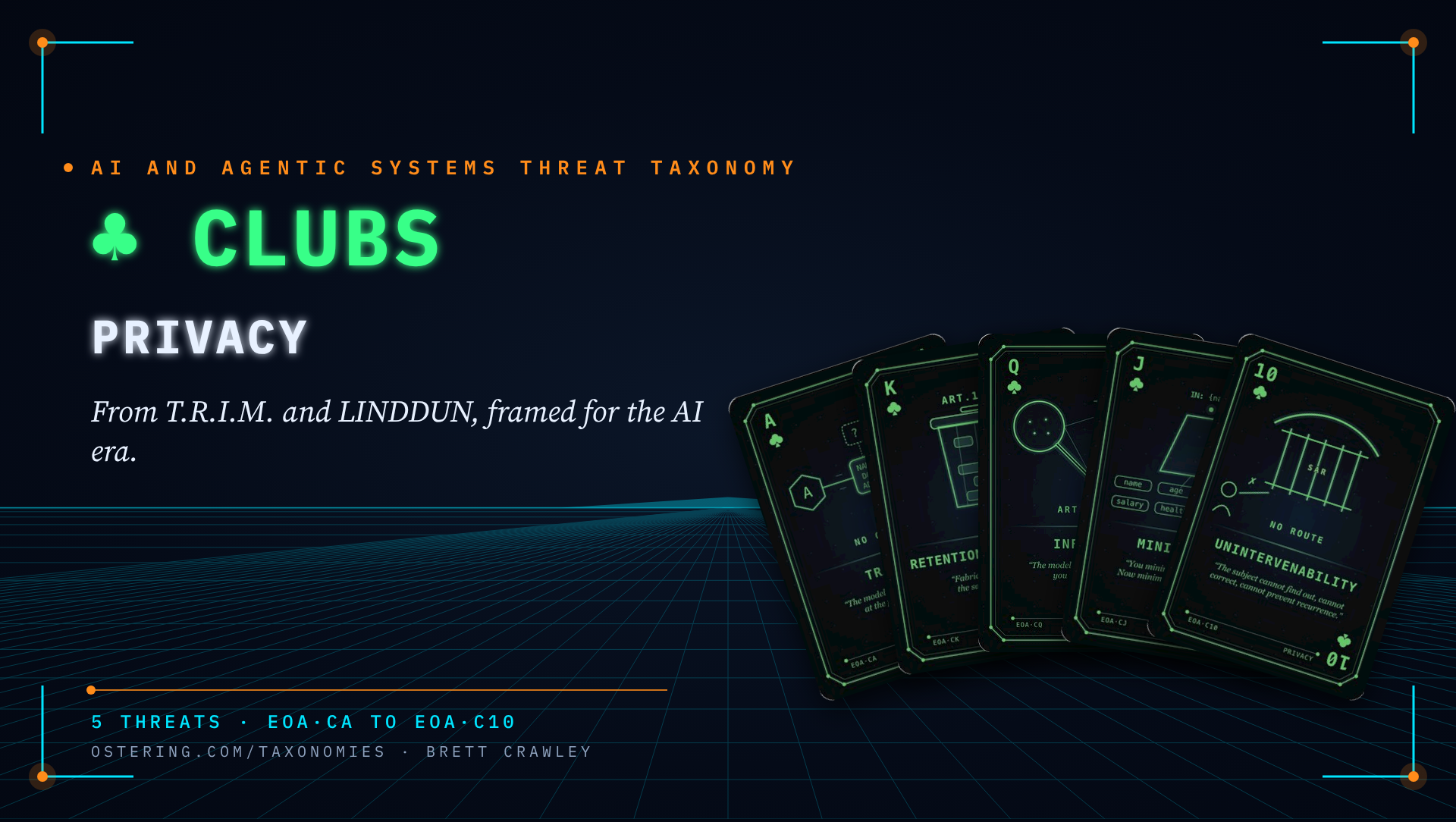
Taxonomies / AI and Agentic Systems Threat Taxonomy / Clubs
♣ Clubs: Privacy
Privacy threats from T.R.I.M. and LINDDUN, framed for systems that generate personal data as well as process it: transfer, retention and removal, inference, minimisation and unintervenability.
This suit has 5 cards, EOA·CA to EOA·C10. In the game, high ranks (Ace, King) are the broader or more foundational threats and low ranks the more specific or variant ones; in the taxonomy the ID is a stable reference, not a severity. Each entry gives the card’s threat and mitigation prompts, the mitigation principle a sound design follows, design measures, and mappings.
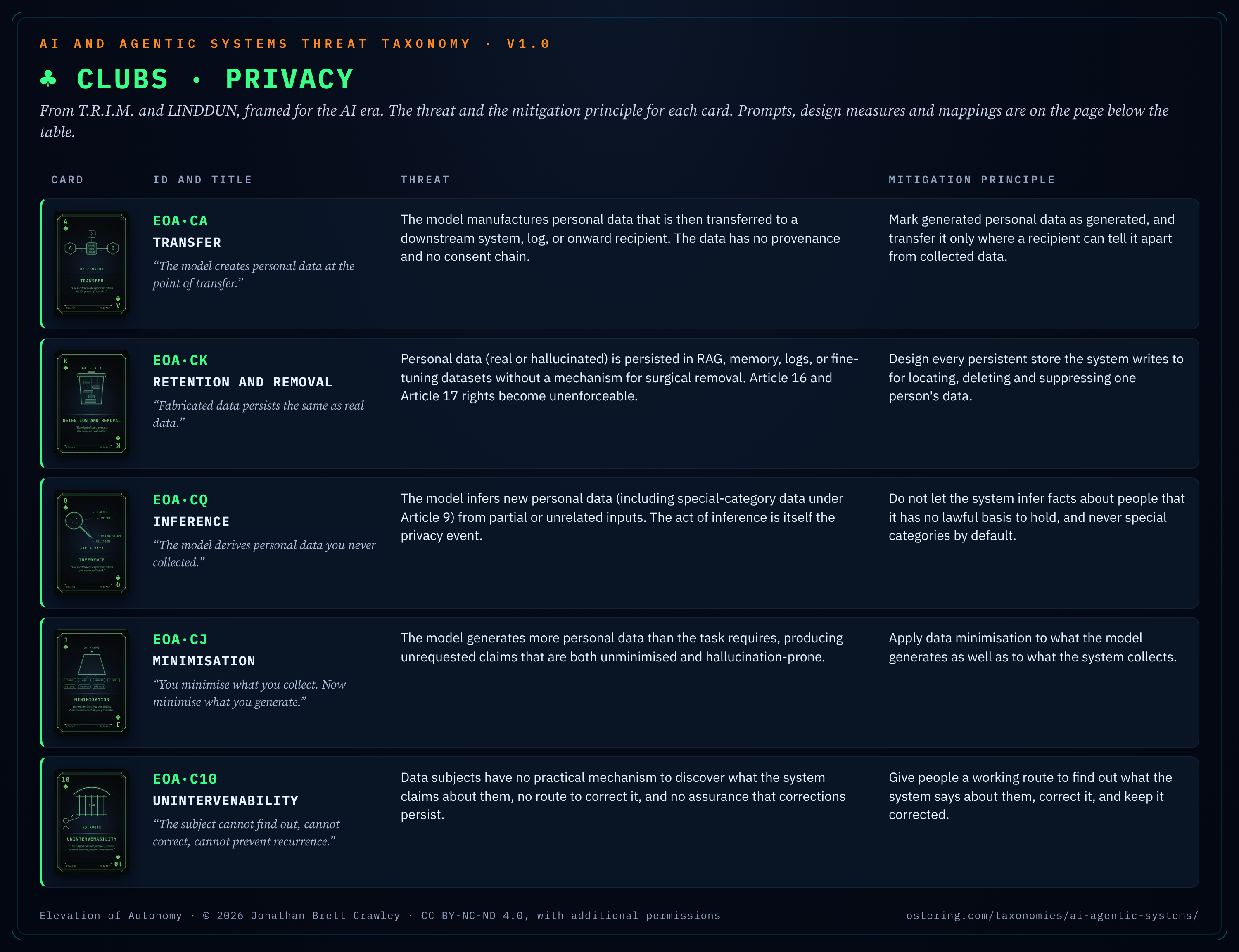
The entries
EOA·CA Transfer
“The model creates personal data at the point of transfer.”
Threat. The model manufactures personal data that is then transferred to a downstream system, log, or onward recipient. The data has no provenance and no consent chain.
Mitigation prompts (from the card)
- Does the data carry provenance tags?
- Can downstream consumers distinguish generated from collected data?
- Is onward transfer logged?
Mitigation principle. Mark generated personal data as generated, and transfer it only where a recipient can tell it apart from collected data.
Design measures
- Tag every record and field the model produces with its provenance (generated, retrieved, collected) and carry the tag through transfers.
- Make downstream schemas store generated personal data separately from collected data, or reject it.
- Log every onward transfer of personal data from model output: what, to whom and on what basis.
- Include model-generated data in the record of processing and in transfer impact assessments.
Mappings
- STRIDE: I
- LINDDUN: Data disclosure, Non-compliance
- Card references: T.R.I.M. Transfer. GDPR Article 5(1)(a), 5(1)(b).
- MITRE ATLAS: none
- CAPEC: none
- CWE: none
Touches: EOA·DQ Hallucinated Facts, EOA·CK Retention and Removal, EOA·HJ Cascading Failure
EOA·CK Retention and Removal
“Fabricated data persists the same as real data.”
Threat. Personal data (real or hallucinated) is persisted in RAG, memory, logs, or fine-tuning datasets without a mechanism for surgical removal. Article 16 and Article 17 rights become unenforceable.
Mitigation prompts (from the card)
- For each persistent store: can you locate a specific individual’s data?
- Can you delete it?
- Can you prevent recurrence?
Mitigation principle. Design every persistent store the system writes to for locating, deleting and suppressing one person’s data.
Design measures
- Index personal data by data subject across RAG, memory, logs, caches and training sets, so one person’s data can be found.
- Support deletion in each store, with a retention period, and keep personal data out of fine-tuning sets unless it can be removed and the model retrained.
- Add a suppression list applied at output for corrections and erasures that cannot be removed from model weights.
- Test the process end to end with synthetic subject access and erasure requests.
Mappings
- STRIDE: I
- LINDDUN: Non-compliance, Unawareness and unintervenability
- Card references: T.R.I.M. Retention. GDPR Articles 16, 17.
- MITRE ATLAS: none
- CAPEC: none
- CWE: none
Touches: EOA·SJ Memory Poisoning, EOA·C10 Unintervenability, EOA·DK Vector and Embedding Weakness
EOA·CQ Inference
“The model derives personal data you never collected.”
Threat. The model infers new personal data (including special-category data under Article 9) from partial or unrelated inputs. The act of inference is itself the privacy event.
Mitigation prompts (from the card)
- What does the model infer about people that it was not told?
- Does it ever touch special categories?
- What is the lawful basis for inferred data?
Mitigation principle. Do not let the system infer facts about people that it has no lawful basis to hold, and never special categories by default.
Design measures
- Constrain outputs about identifiable people to retrieved, authoritative facts (refuse-or-ground); no free-form biographical detail.
- Detect and block special-category inferences (health, religion, sexual orientation, political views and the like) at output.
- Record which inferences the product relies on and the lawful basis for each in the DPIA.
- Exclude inputs from the context that enable sensitive inference and that the task does not need (calendars, location history, free-text notes).
Mappings
- STRIDE: I
- LINDDUN: Identifying, Linking
- Card references: T.R.I.M. Inference. GDPR Article 9. LINDDUN Identifying.
- MITRE ATLAS: none
- CAPEC: none
- CWE: none
Touches: EOA·CJ Minimisation, EOA·DA Sensitive Information Disclosure, EOA·C10 Unintervenability
EOA·CJ Minimisation
“You minimise what you collect. Now minimise what you generate.”
Threat. The model generates more personal data than the task requires, producing unrequested claims that are both unminimised and hallucination-prone.
Mitigation prompts (from the card)
- Is the input minimal for the task?
- Is the output minimal?
- Are output schemas constrained to what was asked?
Mitigation principle. Apply data minimisation to what the model generates as well as to what the system collects.
Design measures
- Constrain output to a schema that has only the fields the task needs, with no free-text field for personal data.
- Minimise the input: pass identifiers or redacted text rather than whole records where the task allows.
- Cap response length for tasks that need short answers.
- Strip personal data from outputs that do not need it before they are stored or sent.
Mappings
- STRIDE: I
- LINDDUN: Data disclosure, Non-compliance
- Card references: T.R.I.M. Minimisation. GDPR Article 5(1)(c).
- MITRE ATLAS: none
- CAPEC: none
- CWE: CWE-201 Insertion of Sensitive Information Into Sent Data
Touches: EOA·CQ Inference, EOA·DQ Hallucinated Facts, EOA·CA Transfer
EOA·C10 Unintervenability
“The subject cannot find out, cannot correct, cannot prevent recurrence.”
Threat. Data subjects have no practical mechanism to discover what the system claims about them, no route to correct it, and no assurance that corrections persist.
Mitigation prompts (from the card)
- Is the processing disclosed in the privacy notice?
- Is there a subject access process that covers model outputs?
- Do rectifications persist across sessions?
Mitigation principle. Give people a working route to find out what the system says about them, correct it, and keep it corrected.
Design measures
- Disclose the AI processing, including generated and inferred data, in the privacy notice.
- Extend the subject access process to model outputs, memory, logs and RAG stores.
- Make rectification persistent: corrections stored in the system of record and applied at retrieval and output in every later session.
- Give people affected by a decision a route to human review, and record each request and its outcome.
Mappings
- STRIDE: R
- LINDDUN: Unawareness and unintervenability, Non-compliance
- Card references: LINDDUN Unawareness/Unintervenability. GDPR Articles 13, 14, 16.
- MITRE ATLAS: none
- CAPEC: none
- CWE: none
Seen in the wild. noyb filed a complaint with Norway’s data protection authority after ChatGPT falsely described a Norwegian man as having murdered his children, mixing in real details of his life; noyb argued OpenAI offered no way to correct the output. March 2025. Source: OpenAI faces European privacy complaint after ChatGPT allegedly hallucinated man murdered his sons (Euronews).
Touches: EOA·CK Retention and Removal, EOA·T1 Wrong Abstraction, EOA·CA Transfer
Mappings at a glance
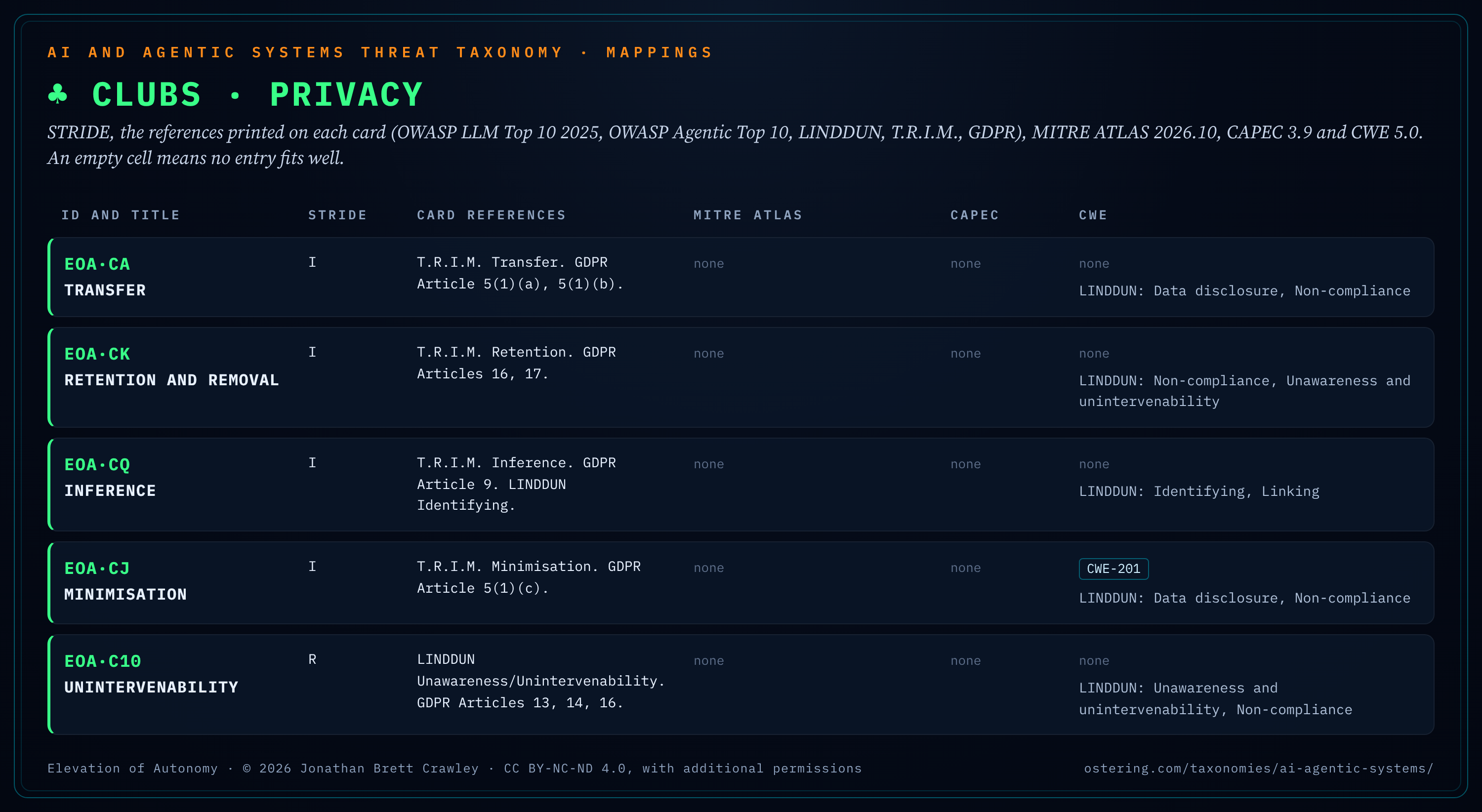
STRIDE across this suit: Repudiation 1, Information disclosure 4. 0 of 5 entries map to MITRE ATLAS, 0 to CAPEC and 1 to CWE.
Where this suit touches the others
- Diamonds: Data: EOA·CA with EOA·DQ; EOA·CJ with EOA·DQ; EOA·CK with EOA·DK; EOA·CQ with EOA·DA.
- Hearts: Autonomy: EOA·CA with EOA·HJ.
- Spades: Adversarial: EOA·CK with EOA·SJ.
- Trumps: Structural Hazards: EOA·C10 with EOA·T1.
Previous: ♦ Diamonds: Data · Overview · Next: ★ Trumps: Structural Hazards
AI and Agentic Systems Threat Taxonomy v1.0, the reference for the Elevation of Autonomy card deck. © 2026 Jonathan Brett Crawley. Licensed under CC BY-NC-ND 4.0 with additional permissions: see the licence.